Quick answerForeigners without a residence permit use a potential tax number (potansiyel vergi numarası), a 10 digit number issued by GİB. Apply on dijital.gib.gov.tr with your passport details; if the check fails, usually because that passport was never used to enter Türkiye, apply at a tax office or through a lawyer. Residence or work permit holders use their 11 digit foreigner identity number starting with 99 (sole tax number since 1 July 2010). Under Law No. 4358 the number is required for bank accounts, title deeds, notary deeds and car registration, but creates no tax liability.
Almost every foreigner who does something official in Türkiye is asked the same question within the first few minutes: "What is your tax number?" The bank asks it before opening an account, the land registry asks it before a title deed is signed, the notary asks it before a car sale or a power of attorney, and the tax payment screens ask for it before you can pay the fee for an imported phone. The Revenue Administration, Gelir İdaresi Başkanlığı (GİB), now offers the application for foreigners on its Digital Tax Office at dijital.gib.gov.tr, and much of the guidance in circulation still describes older screens. This guide explains the Turkish tax number for foreigners as it works now: the difference between a potential tax number and a foreigner identity number, how to get a tax ID in Türkiye online, at a tax office or from abroad, which documents are needed, what the number is used for, and when it turns into a real tax registration with filing obligations.
1. What a Turkish Tax Number Is and Why Foreigners Need One
The Turkish tax identification number, vergi kimlik numarası, the identifier the tax administration assigns to each person or company, is not only a tax filing tool. Under the Law on the Dissemination of the Use of Tax Identification Numbers, Law No. 4358 of 2 April 1998, public bodies and private persons carrying out transactions designated by the Ministry of Finance must record the tax number of the people involved. Article 2 of Law No. 4358 adds that a party to such a transaction who has no tax number must obtain one before the transaction is completed. In practice, this means that the tax number works as a general identification number for financial and legal transactions.
Turkish citizens use their national identity number for this purpose. A foreigner has no national identity number, so the system gives them one of two alternatives: a ten digit tax number issued by the Revenue Administration, or an eleven digit foreigner identity number issued by the Ministry of Interior. Law No. 4358 also amended several other statutes, including the Notaries Law, the Land Registry Law and the Highway Traffic Law, so that the tax number became a required entry in notarial deeds, title deed contracts and vehicle registrations. Article 5 of Law No. 4358 makes it an offence to conceal a tax number, to make a knowingly false statement about it or to present false or misleading documents, punishable by imprisonment from three to ten months.
2. Potential Tax Number and Foreigner Identity Number: Two Different Numbers
Most confusion among foreigners comes from the fact that two different numbers can serve as the "tax number", and the people asking for it rarely explain which one they mean.
2.1 The Potential Tax Number
The potential tax number, potansiyel vergi kimlik numarası, a tax number created for a person who has no tax liability yet, is a ten digit number issued by the Revenue Administration to a foreigner who does not hold a Turkish identity number. The word "potential" reflects its nature: the number exists in the tax system and identifies you, but on its own it does not make you a registered taxpayer and does not create any obligation to file returns. It is the number a tourist, a property buyer who lives abroad, or a foreign investor uses before any residence permit exists. It is often called simply the "vergi numarası" by bank staff and estate agents.
2.2 The Foreigner Identity Number
The foreigner identity number, yabancı kimlik numarası (YKN), is an eleven digit number that begins with 99. Article 8 of the Civil Registration Services Law, Law No. 5490, authorises the Ministry of Interior to assign identity numbers to foreigners within the scope of the Law on Foreigners and International Protection, Law No. 6458, and also, upon request, to foreigners who apply to a public institution in Türkiye or to a Turkish embassy or consulate in connection with any transaction. In practice, most foreigners receive this number automatically when a residence permit or work permit is granted, and it is printed on the residence permit card.
Under the Tax Identification Number General Communiqué No. 4, published in the Official Gazette of 22 May 2010 (No. 27588), from 1 July 2010 foreign individuals who have a foreigner identity number must use only that number as their tax number in all transactions. The ten digit number issued by a tax office remains in use only for foreigners who have no foreigner identity number.
2.3 Which Number to Use When
| Element | Current Rule |
|---|
| Potential tax number | Ten digits, issued by the Revenue Administration online or by a tax office; for foreigners without a foreigner identity number |
| Foreigner identity number (YKN) | Eleven digits starting with 99, issued by the Ministry of Interior under Article 8 of Law No. 5490, usually with a residence or work permit |
| Which one counts as the tax number | The YKN, if you have one (Communiqué No. 4, from 1 July 2010); otherwise the ten digit potential number |
| Tax liability created by the number itself | None; liability arises only from taxable activity or income |
| Fee for the online application | The Digital Tax Office form has no payment step |
| Typical first uses | Bank account, title deed, notarial deeds, vehicle registration, phone fee payment |
A simple rule follows from the table: if you hold a Turkish residence permit or work permit, give your 99 number; if you do not, you need a potential tax number.
3. How to Get a Tax ID in Türkiye Online
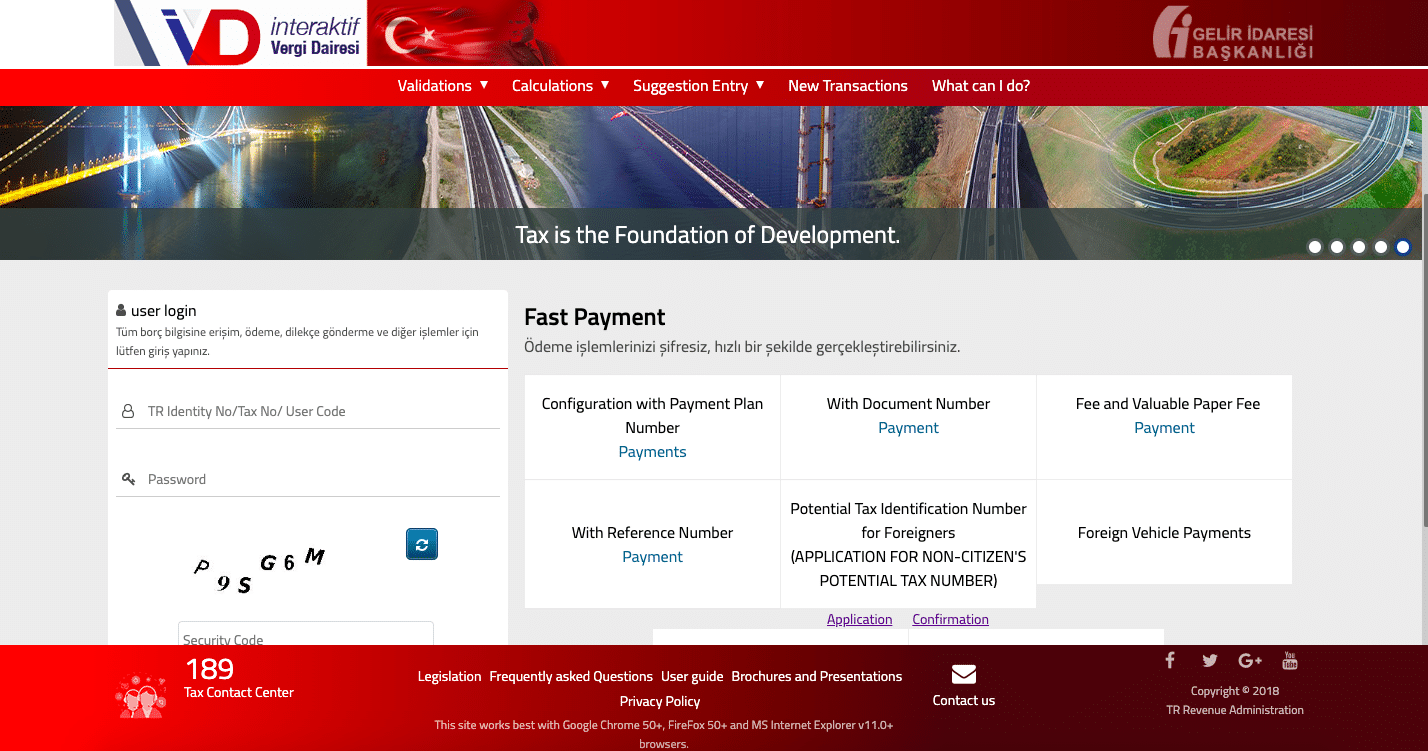
The fastest route is the online application on the Revenue Administration's Digital Tax Office, Dijital Vergi Dairesi. Older guides refer to the Interactive Tax Office, İnteraktif Vergi Dairesi, at ivd.gib.gov.tr, which hosted the same service before the Digital Tax Office. A Tax Procedure Law General Communiqué published in the Official Gazette of 7 October 2023 (No. 32332) lists the inquiry of potential tax numbers for foreigners among the Digital Tax Office services. The application itself is open to the public without a login.
3.1 The Digital Tax Office Application Form
The page is titled "Yabancılar İçin Potansiyel Vergi Kimlik Numarası Başvurusu (Potential Tax Number Application for Foreigners)" and is found at dijital.gib.gov.tr under the foreigners section. The form is bilingual and asks for:
- name and surname exactly as written in the passport;
- gender;
- foreigner identity number, if you have one;
- place of birth;
- mother's name and father's name;
- country of nationality and passport number;
- mobile phone number and address.
You then confirm the accuracy of the information and press "Başvur (Apply)". Where the system can verify your identity and passport details, the number is displayed on screen. Write it down or take a screenshot at once. If you lose it later, the Digital Tax Office also offers an inquiry service for potential tax numbers of foreigners, so there is no need to apply again.
Two practical points save time. First, enter your parents' names and your place of birth as they appear in your entry records; transliteration differences, particularly for Arabic, Persian, Russian or Chinese names, are the most common reason for failure. Second, earlier versions of the service asked for a photograph of the passport photo page (up to 1 MB), so keep a clear scan ready in case the screen requests it.
3.2 When the Online Check Fails
The online system checks your data against the identity and passport records held by the state. In practice it usually succeeds only where you have already entered Türkiye with the passport you are applying with. If you have never visited, or entered with an older passport, the check normally fails with the warning "Kimlik ve pasaport bilgilerinizin doğruluğu sağlanamadı" (the accuracy of your identity and passport information could not be confirmed). An announcement of the Istanbul Provincial Directorate of Migration Management dated 25 November 2020 stated that tax offices were accepting in person applications only from people who had received this warning despite entering all their information correctly, and directed everyone else to the online service. Practice varies between offices, but you should expect a tax officer to ask whether you tried online first.
4. Applying in Person at a Tax Office
If the online route is not available to you, the number is issued by a tax office, vergi dairesi. Any tax office can issue a potential number; you do not need to go to the office of a particular district, although for later tax registration the competent office is determined by your address or the location of your property or business.
4.1 Documents
The Revenue Administration's own guide on income of persons not resident in Türkiye states that, to obtain a tax number, an individual must submit either a notarised copy of the passport, or the original passport together with a photocopy so that the tax office can certify the copy itself. For citizens of the Turkish Republic of Northern Cyprus, presentation of the identity card is sufficient. In practice, you should bring:
- your valid passport and a photocopy of the photo page;
- a short petition or the office's request form with your address, which may be an address abroad;
- your mother's and father's names and your place of birth, written as in the passport;
- a Turkish mobile number if you have one, as later services use SMS verification.
The officer enters the details and normally prints a document showing the number the same day. Keep it with your passport copy, because banks and land registry offices sometimes want to see it.
4.2 Applying Through a Lawyer or Representative
A foreigner who is not in Türkiye can authorise a lawyer to obtain the number. The representative needs a notarised power of attorney that expressly covers dealings with tax offices and obtaining a tax number, together with a notarised copy of the passport. If the power of attorney is signed abroad, it must be signed before a Turkish consulate or before a local notary with an apostille and a sworn Turkish translation; our article on the power of attorney in Türkiye explains both routes. Many property buyers combine the tax number, the bank account and the title deed transfer in one power of attorney, which avoids several separate trips.
5. Obtaining a Tax Number From Abroad and Through a Bank
For people who have not yet travelled to Türkiye there are three realistic routes. The first is a lawyer with a power of attorney, as described in section 4.2 above. The second is a Turkish embassy or consulate: Article 8 of Law No. 5490 allows a foreigner identity number to be assigned upon request to foreigners who apply to Turkish diplomatic and consular missions in connection with a transaction, and a foreigner identity number serves as the tax number under Communiqué No. 4. Whether a particular consulate offers this service, and the documents it asks for, differ from mission to mission, so contact the consulate before making an appointment.
The third route runs through the bank. The Revenue Administration's guide states that banks, intermediary institutions and custodians whose foreign clients cannot present a tax number may obtain numbers for them in bulk by completing the "Tax Identification Number Request Form for Foreigners" attached to its General Letter of 7 November 2003 (No. 48244), and sending it with the client's documents to the Boğaziçi Tax Office in Istanbul. This route is designed mainly for foreign investors who hold financial instruments through Turkish banks, and not every bank uses it for ordinary retail accounts.
6. Using the Tax Number to Open a Bank Account
Banks are among the institutions brought within the tax number scheme by Law No. 4358, and in practice no Turkish bank opens an account for a foreigner without a tax number. A visitor without a residence permit therefore usually obtains a potential number first, often on the same day, and then goes to the branch with the passport, the tax number document and proof of address. Banks also apply their own customer due diligence rules, so some branches ask for additional documents such as proof of income or a reason for opening the account, and approval for persons not resident in Türkiye is at the bank's discretion. Our article on how foreigners can open a bank account in Türkiye covers those requirements in detail.
If you later receive a residence permit, give the bank your 99 number so that your customer record is updated. A bank account held under an old potential number while you already have a foreigner identity number is a frequent cause of rejected transfers, frozen online banking and mismatches in tax reporting.
7. Using the Tax Number for a Property Purchase
A foreigner cannot sign a title deed in Türkiye without a tax number. Article 26 of the Land Registry Law, Law No. 2644, as amended by Law No. 4358, provides that the tax identification numbers of the parties are recorded in the official deed together with their identity information. The title deed fee is also paid under that number.
The tax number is only one element of the file. The buyer's nationality must be one permitted to acquire property under Article 35 of Law No. 2644, the area limits in that article must be respected, and the land registry will ask for further documents, translations where the buyer does not speak Turkish and, if the buyer is absent, a power of attorney. The full sequence is set out in our guide to real estate purchase procedures for foreigners in Türkiye. A practical tip from transactions we handle: make sure the name on the tax number record matches the passport character for character, because the land registry compares them and even a missing middle name can delay the appointment.
If you rent the property out, the tax number becomes your taxpayer identifier for rental income. The Revenue Administration's 2026 guidebook for landlords who are not resident in Türkiye states that rental income returns for 2025 were to be filed between 1 March and 31 March 2026, either through a tax representative or, without one, after registration with the tax office where the property is located.
8. Phone Lines and Imported Phone Registration
A prepaid line bought by a visitor is normally registered against the passport, and a tax number is not usually needed for that. The tax number becomes relevant when you want to keep using a phone brought from abroad beyond the initial period. The fee payment screen for imported phones on the Digital Tax Office asks for a "T.C. / Yabancı Kimlik Numarası", a Turkish or foreigner identity number, and links directly to the potential tax number application for those who have neither.
Since 2 July 2026 the registration itself is completed only through e-Devlet, the state's online services portal, where foreigners log in with their foreigner identity number and an e-Devlet password. A short stay visitor with only a potential tax number should therefore confirm that the whole process can be completed before paying the registration fee. The deadlines, the 2026 fee and the e-Devlet steps are explained in our article on registering imported phones in Türkiye.
9. Cars, Notary Transactions and Other Everyday Uses
Notaries cannot complete most transactions without your tax number. The Notaries Law, Law No. 1512, requires the tax number of the person concerned to appear in notarial deeds (Article 84), in certification annotations (Article 92) and in notarial minutes (Article 101). This covers powers of attorney, vehicle sales, rental contracts certified by a notary and sworn declarations.
For vehicles, Article 20 of the Highway Traffic Law, Law No. 2918, obliges owners to apply for registration within three months of purchase or customs clearance and to provide their tax identification number with the documents listed in the regulation. Whether a foreigner without a residence permit can register a car on Turkish plates in their own name is a separate question governed by the vehicle registration rules, so check it before paying for a car. Foreigners bringing their own vehicle should read our article on foreign plated vehicles in Türkiye.
Other common uses include utility subscriptions, insurance policies, tenancy deposits paid through a bank, company formation as a shareholder, and payments of fees and fines on the Digital Tax Office.
10. Employment, Residence Permits and the Switch to the 99 Number
Once you obtain a residence permit, or a work permit, which under Article 12 of the International Labour Force Law, Law No. 6735, substitutes for a residence permit, you receive a foreigner identity number beginning with 99. From that moment the potential number should no longer be used. Your employer will report your salary and social security premiums under the 99 number, and the same number gives access to e-Devlet and to the tax services that require a login. Our guide to residence permits in Türkiye explains when the number is issued.
The two records are not always merged automatically. Communiqué No. 4 already required foreigners with existing tax records to notify their tax office of their foreigner identity number, and in practice people who bought property or opened accounts under a potential number often find two separate records. Visit the tax office with your residence permit card and the document showing your old number, and ask for the records to be matched; then update the bank, the land registry and any notary or company records.
11. When the Potential Number Becomes a Real Tax Registration
Holding a tax number does not make you a taxpayer. Tax liability, mükellefiyet, the status of being registered with obligations to file and pay, arises from taxable activity or income, not from the number. The common triggers for foreigners are:
- starting a commercial, craft or professional activity in your own name: Article 153 of the Tax Procedure Law, Law No. 213, requires the start of business to be notified to the tax office, and Article 168 sets a period of ten days from the start of business, which may be handled by a licensed lawyer or certified accountant;
- receiving rental income from Turkish property that must be declared: when the rental income return is approved on the Revenue Administration's ready declaration system, the tax liability record is created automatically, as the 2026 guidebook explains;
- selling property or shares in circumstances that create taxable gains, or receiving other income that is not fully taxed through withholding.
Once a liability record exists, you have filing deadlines, possible penalties for late filing and, for business activity, bookkeeping obligations. A foreigner who expects any of these should take advice on residence status and double taxation treaties before the first return. Our tax law team handles registrations, rental income returns and disputes with tax offices for foreign clients.
12. Frequently Asked Questions
12.1 What is a potential tax number in Türkiye?
It is a ten digit tax number issued by the Revenue Administration to a foreigner without a Turkish identity number, used to identify the person in banking, property, notary and other transactions without creating any tax liability.
12.2 Is the potential tax number the same as the foreigner identity number?
No. The potential number has ten digits and comes from the tax administration; the foreigner identity number has eleven digits, starts with 99 and is issued by the Ministry of Interior, usually with a residence permit.
12.3 I have a residence permit. Do I still need a separate tax number?
No. Since 1 July 2010 the foreigner identity number on your residence permit is your tax number for all transactions under Communiqué No. 4.
12.4 How do I get a vergi numarası as a foreigner online?
Use the "Potential Tax Number Application for Foreigners" form on dijital.gib.gov.tr, entering your passport and family details; if the system verifies them, the number appears on screen immediately.
12.5 Why does the online application fail?
Usually because the passport has not been used to enter Türkiye or the names entered do not match the entry records; in that case apply in person at a tax office.
12.6 What documents do I need at the tax office?
Your passport with a photocopy, or a notarised passport copy, and your address; the office certifies the copy against the original.
12.7 Can I get a Turkish tax number without visiting Türkiye?
Yes, through a lawyer holding a notarised power of attorney, and in some cases through a Turkish consulate or your bank.
12.8 Is there a fee for a Turkish tax number?
The online application on the Digital Tax Office has no payment step; costs arise only if you use a notary, translator or lawyer.
12.9 Does having a tax number mean I must file tax returns?
No. Filing obligations start only when you have taxable activity or income, such as a business or declarable rental income.
12.10 Do I need a tax number to buy property in Türkiye?
Yes. Article 26 of Law No. 2644 requires the parties' tax numbers to be recorded in the title deed contract.
12.11 Can I open a bank account with only a passport?
No. Banks require a tax number as well, although a visitor can usually obtain a potential number on the same day before going to the branch.
12.12 I lost my potential tax number. How do I find it?
Use the potential tax number inquiry service for foreigners on the Digital Tax Office, or ask any tax office to look it up with your passport.
12.13 What happens to my potential number when I get a residence permit?
You should start using the 99 number and ask the tax office to match the two records, then update your bank and other institutions.
12.14 Does the tax number expire?
The number is not issued for a fixed period; if you get a new passport, ask the tax office to update the record rather than applying for a second number.
13. Conclusion
A Turkish tax number for a foreigner is either the ten digit potential tax number issued by the Revenue Administration or, for residence and work permit holders, the eleven digit foreigner identity number beginning with 99, which has been the only valid tax number for its holders since 1 July 2010. The potential number is obtained online on the Digital Tax Office when the passport has been used to enter Türkiye, and otherwise at a tax office, through a lawyer or, in some cases, through a consulate or bank. Law No. 4358 makes the number a precondition for bank accounts, title deeds, notarial deeds and vehicle registrations, but the number alone creates no tax liability until there is business activity or declarable income.
The problems we see most often are not with getting the number but with what follows: two records for one person, name mismatches that stop a title deed appointment, and rental income that was never declared. If you need a tax number before arriving, want your records matched after a residence permit, or have received a letter from a tax office, please contact our legal team.