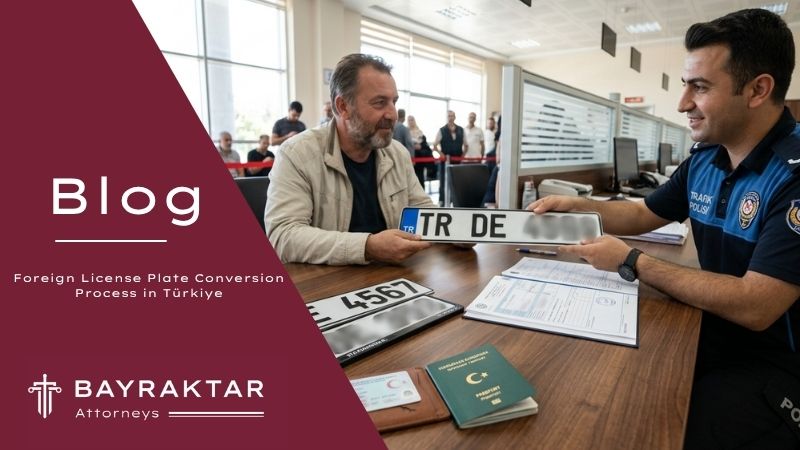
Quick answerA foreign-registered vehicle can be brought into Türkiye temporarily by someone who has lived abroad at least 185 days within the preceding 12 months, allowing use for up to 730 days; overseas retirees are exempt from the 185-day rule but face the same two-year cap. Converting to a Turkish plate is only available to Turkish citizens returning permanently after at least two years abroad, with the vehicle no older than 3 years, following a strict sequence: blue plate first, then inspection. Converted vehicles carry a one-year resale restriction.
The 185-day residency rule, who qualifies, required documents, the blue plate process, converting to Turkish plates, the vehicle inspection sequence, new family usage rights, and selling the converted vehicle.
For foreign nationals, overseas Turks, and expats who own a vehicle registered abroad, bringing that vehicle to Turkey and keeping it legally on the road involves a set of specific procedural requirements that must be met in the correct order. Errors in this process, particularly at the plate conversion and vehicle inspection stages, can be costly and difficult to reverse.
This guide covers every stage: the initial entry procedures, who qualifies to bring a foreign-plated vehicle into Turkey, the documents required at the border, how the 185-day residency rule works, the use of power of attorney for exiting the vehicle, converting a foreign plate to a Turkish plate, the critical vehicle inspection requirement, the recent reform allowing family members to drive the vehicle, and what happens when you want to sell the vehicle after conversion.
At Bayraktar Attorneys, we advise foreign nationals and overseas Turkish citizens on the full range of vehicle import, registration, and customs matters. Given the interdependent steps in this process and the significant financial consequences of procedural errors, working with a legal adviser from the outset is strongly recommended.
Answer-first: A foreign-registered vehicle may be brought into Turkey temporarily by a person who has been resident abroad for at least 185 days in the preceding 12 months and who is the registered owner of the vehicle. The maximum period of use in Turkey is 730 days (two years). Converting a foreign plate to a Turkish plate is only possible for Turkish citizens returning permanently from abroad, subject to strict conditions, and the conversion process must follow a specific sequence, including a vehicle inspection after the plate conversion, which is mandatory and must not be skipped.
1. General Framework: Bringing a Foreign-Plated Vehicle to Turkey
The temporary admission of foreign-registered vehicles into Turkey is governed by Turkish customs regulations and is subject to bilateral economic agreements between Turkey and the vehicle's country of registration. The applicable procedures can vary depending on which country the vehicle is registered in, since some bilateral agreements provide more favorable terms than others.
Before bringing any foreign-registered vehicle into Turkey, the owner must notify the Turkish Ministry of Customs and Trade, providing detailed specifications of the vehicle. At the point of entry, a customs declaration must be filed and the vehicle's documents must be presented to customs authorities. The vehicle must also comply with Turkish environmental and road safety standards, which may require a roadworthiness inspection at an authorized testing station (TUVTURK). Additionally, compulsory Turkish traffic insurance (zorunlu trafik sigortasi) must be obtained before the vehicle can legally be driven on Turkish roads.
2. Who Can Bring a Foreign-Plated Vehicle Into Turkey?
2.1. The General Residency Requirement
The right to bring a single foreign-registered land vehicle into Turkey on a temporary basis belongs to persons who are resident abroad and whose vehicle is registered in their own name. Two conditions must both be satisfied:
- Residence abroad: the person must have their habitual residence outside Turkey. Persons who have gone abroad temporarily for education or work and have then returned definitively to Turkey are considered to be resident in Turkey and do not qualify.
- The 185-day rule: within the 12-month period immediately preceding the date of entry into Turkey, the person must have been physically present outside Turkey for at least 185 days in total. This period can be accumulated across multiple trips abroad; it does not need to be continuous.
The 185-day period is calculated automatically by a system that draws on passport entry and exit records held by the General Directorate of Security. The person does not self-certify this period: the system verifies it at the point of entry.
Important: The 185-day requirement must be satisfied afresh at each entry into Turkey. It is not a one-time qualification. A person who met the 185-day rule in a previous year but has spent more time in Turkey in the current year may not qualify at their next entry. Track your entry and exit dates carefully.
2.2. Special Rule for Overseas Retirees
Persons who have retired from employment abroad are subject to a different rule. For overseas retirees, the 185-day requirement does not apply. The retiree must simply present proof of their retirement status and confirmation of their residence abroad. A pension certificate or retirement document, officially translated into Turkish and certified by the relevant consulate or embassy, is the standard documentation.
An important additional rule applies to retirees who have not used the full 730-day allocation in a previous admission: if they return to Turkey with their vehicle before the 730-day period has expired, they may continue using the vehicle for the remainder of the original 730-day period without needing to satisfy the 185-day rule again.
2.3. Maximum Duration of Use in Turkey
Regardless of whether the person is a retiree or a standard overseas resident, the vehicle may be used in Turkey for a maximum period of two years (730 days) in total. For foreign nationals, the duration is also linked to the validity period of their residence permit: the residence permit issued to a foreign national cannot exceed two years, and the permitted period for the vehicle is aligned with this.
For persons without a Turkish residence permit, the vehicle may be used for 90 days from the date of entry. Where the person departs Turkey and returns with the vehicle, the remaining period from the original admission is carried forward.
| Category |
185-Day Rule? |
Maximum Duration in Turkey |
| Overseas resident (standard) |
Yes, required at each entry |
730 days (2 years) |
| Overseas retiree |
No |
730 days (2 years) |
| Foreign national with Turkish residence permit |
Yes |
Up to 2 years (aligned with permit) |
| Foreign national without Turkish residence permit |
Yes |
90 days from entry date |
| Corporate vehicle brought by power of attorney |
N/A |
30 days |
2.4. Vehicles Owned by Legal Entities
Where the vehicle is owned by a legal entity (company, foundation, or other corporate body) rather than an individual, it may be brought into Turkey by power of attorney. In this case, the person bringing the vehicle (whether an employee, shareholder, or authorized representative of the entity) is granted a period of up to 30 days. The vehicle types covered include cars, minibuses, off-road vehicles, light commercial vehicles (kamyonet), and motorcycles.
3. Required Documents at the Turkish Border
The following documents must be available at the point of entry into Turkey:
- Vehicle registration certificate (ruhsat)
- Valid driving licence of the person bringing the vehicle
- Document confirming overseas residence (residence permit, utility bill, or equivalent official document issued by the foreign country)
- Valid passport or equivalent identity document
- Compulsory Turkish traffic insurance (must be obtained before or at the border)
- For overseas retirees: pension or retirement certificate, officially translated into Turkish and certified by the relevant Turkish consulate or embassy
- Where applicable: a valid power of attorney or vehicle rental agreement
- For corporate-owned vehicles: a document confirming that the person bringing the vehicle is a shareholder or employee of the owning entity, notarized or consulate-certified and translated into Turkish
4. Using the Remaining Admission Period
Where a person has previously brought their vehicle into Turkey under the 185-day rule and used only part of their 730-day allocation, the unused portion is carried forward. The calculation is straightforward: the number of days already used within Turkey is subtracted from 730, and the remainder is the period the person can use on their next admission.
This carry-forward mechanism applies provided the person satisfies the 185-day rule again at the point of re-entry (or qualifies as an overseas retiree).
5. Key Points About the 185-Day Rule
The 185-day rule is the most frequently misunderstood aspect of the foreign vehicle admission system. The following points are the most practically important:
- The 185 days are counted within the 12-month period immediately before the date of entry into Turkey. They do not need to be consecutive.
- The 185-day requirement must be met afresh at each entry into Turkey. Qualifying in a previous year does not automatically qualify a person in the current year.
- Days spent in Turkey without the vehicle (i.e. where the person entered Turkey but the vehicle remained abroad or was not with the person) are not counted against the vehicle's admitted period.
- Foreign nationals without a Turkish residence permit who leave Turkey and return with their vehicle may use the remaining portion of the original 90-day period.
From Our Practice: The most common error we encounter is where a client has spent more time in Turkey than they realized over the preceding 12 months and does not meet the 185-day rule at the point of a planned entry with their vehicle. Because the calculation is made automatically from passport records, there is no manual override. We recommend that clients who divide their time between Turkey and another country maintain a personal record of their border crossings and calculate their days abroad before each planned vehicle entry, rather than relying on an approximate recollection.
6. Who Can Drive a Foreign-Plated Vehicle in Turkey? The New Family Member Rule
Under the previous rules, a foreign-plated vehicle could only be driven by the registered owner. This created significant practical difficulties for families, particularly where the registered owner needed to travel but wanted to leave the vehicle available for family members in Turkey.
A recent regulatory amendment has significantly liberalized these rules. The new framework distinguishes between two scenarios:
6.1. While the Vehicle Owner Is Present in Turkey
When the registered owner of the foreign-plated vehicle is physically present in Turkey, the following persons may also drive the vehicle, provided they are resident abroad:
- Spouse
- Children
- Parents (mother and father)
- Grandchildren
These individuals must also be resident abroad to qualify under this provision. Family members who are resident in Turkey do not qualify under the general rule.
6.2. Emergency Use by Turkey-Resident Family Members
In emergency situations, even family members who are resident in Turkey may drive the foreign-plated vehicle. The categories of person who may drive in an emergency are:
- Spouse
- Children
- Parents (mother and father)
- Grandchildren
The new family member driving rules represent a meaningful practical improvement for families who use foreign-plated vehicles in Turkey. However, the distinction between the general rule (overseas-resident family members when owner is present) and the emergency exception (Turkey-resident family members in emergencies) is important. Using the emergency exception for routine driving when the owner is absent is not permitted and could expose both the driver and the owner to regulatory risk.
7. Taking the Vehicle Out of Turkey by Power of Attorney
Where the registered owner of a foreign-plated vehicle cannot personally drive the vehicle out of Turkey (for example, because of illness, an unexpected commitment, or a change of plans), the vehicle can be taken out of Turkey by another person acting under a power of attorney. The procedural requirements depend on the form of the power of attorney:
- Where both the grantor and the holder of the power of attorney are in Turkey: both persons must appear together at the customs office at least 15 days before the vehicle's last permitted exit date. A joint application is required.
- Where the power of attorney has been certified by a Turkish consulate or notarized by a Turkish notary: only the holder of the power of attorney needs to attend the customs office. The consulate or notary certification is sufficient to authorize the holder to act alone.
Important: The 15-day advance application deadline for power of attorney exit procedures is strictly enforced. If the vehicle's permitted period in Turkey is about to expire and a power of attorney exit is needed, the application must be filed at least 15 days before expiry. Missing this deadline can result in significant customs penalties.
8. Converting a Foreign-Plated Vehicle to Turkish Plates
The conversion of a foreign-registered vehicle to Turkish registration (milli plaka, colloquially referred to in the context of the blue plate or mavi plaka process) is one of the most procedurally complex steps in this area. It is subject to strict eligibility conditions and must be carried out in a defined sequence of steps. Doing the steps in the wrong order, or skipping a step, can invalidate the process and create serious complications.
8.1. Who Is Eligible for Plate Conversion?
The right to convert a foreign-registered vehicle to Turkish plates is not available to all persons who bring foreign-plated vehicles into Turkey. The eligibility conditions are as follows:
- Turkish citizens only: a foreign national holding a Turkish residence permit cannot convert their foreign-plated vehicle to Turkish plates. Only Turkish citizens are eligible for this process.
- Minimum two years of overseas residence: the Turkish citizen must have been resident abroad for at least two years continuously.
- Surrender of overseas residence and citizenship rights: the person must formally cancel their overseas residence status and, where applicable, their foreign citizenship rights (where dual nationality is the issue), and must obtain a "definitive return document" (kesin donus evraki) from the relevant Turkish consulate. This requirement does not apply to persons who went abroad temporarily for education or an official posting.
- Vehicle age: as of the date the vehicle was first registered in the owner's name (the date of the ruhsat), the vehicle must not be more than 3 years old.
- 185-day continuous residency prior to return: both the vehicle and the owner must have been continuously present abroad for 185 days immediately prior to the definitive return date. This is a continuous (not cumulative) requirement, which differs from the general 185-day rule for temporary admission.
8.2. The Application Process for Plate Conversion
The plate conversion process involves multiple authorities and must follow a specific sequence. The starting point is the Automobile Specialist Customs Directorate (Oto Ihtisas Gumruk Mudurlugu). The two principal offices handling these applications are located at Haydarpasa and Yesilkoy in Istanbul, though other cities also have competent offices.
The applicant must attend the Automobile Specialist Customs Directorate in person within six months of their definitive return date. During this visit, the customs office will provide detailed face-to-face guidance on the specific documents required and the current process. Given that procedural details can change, and that the customs office's in-person briefing is the authoritative source on current requirements, this initial visit is essential.
8.3. The Blue Plate (Mavi Plaka) Stage
Before the vehicle receives its final Turkish plate, it is typically first issued a blue plate (mavi plaka). This is an interim step in the customs clearance and nationalization process. The blue plate confirms that the vehicle is in the process of being nationalized but has not yet completed all formalities.
8.4. The Critical Sequence: Vehicle Inspection After Blue Plate Issuance
One of the most practically important points in the plate conversion process, and one where errors are common, is the sequence of the vehicle inspection. The vehicle inspection (arac muayenesi) must be carried out after the blue plate has been issued, not before.
This sequence is not optional or variable: it is prescribed by the process, and conducting the inspection in the wrong order can invalidate the results and require the process to be restarted. The correct sequence is:
- Complete the customs formalities and obtain the blue plate from the Automobile Specialist Customs Directorate.
- With the blue plate issued, take the vehicle for its mandatory roadworthiness inspection at an authorized inspection station (TUVTURK).
- Following the inspection, proceed to a notary to have the Turkish plate documentation prepared.
- As a final step, contact the Nakil Vasitalari Vergi Dairesi (Vehicle Tax Office) for registration of the vehicle for tax purposes.
From Our Practice: The inspection sequence issue is one of the most common errors we see in plate conversion cases. Some clients attempt to take the vehicle for inspection before the blue plate is issued, believing this will save time. This is incorrect and can cause the process to break down. The sequence exists for regulatory reasons and must be followed strictly. We advise all clients undergoing plate conversion to obtain legal guidance before beginning the process, not after they have encountered a problem.
9. Selling a Vehicle After Conversion to Turkish Plates
Once the plate conversion process is complete and the vehicle has been registered with Turkish plates, a one-year annotation (serh) is placed on the vehicle's registration. During this one-year period, the vehicle cannot be sold. Attempting to sell the vehicle before this annotation is lifted is not permitted under Turkish law.
After the one-year annotation period has expired, the annotation is automatically lifted and the owner may sell the vehicle through the normal Turkish vehicle sale procedure. There is no special process required: once the annotation is gone, the vehicle can be sold like any other Turkish-registered vehicle.
The one-year annotation on a converted vehicle is frequently overlooked by buyers and sellers. Before purchasing a vehicle that has recently been converted from foreign plates to Turkish plates, a buyer should verify through the title records that the one-year annotation has expired. Purchasing an annotated vehicle does not extinguish the annotation: it remains on the vehicle's registration and the new owner cannot sell the vehicle until the original annotation period has run.
10. Why the Correct Strategy Matters: The Role of Legal Advice
The process of bringing a foreign-plated vehicle into Turkey, and particularly the conversion to Turkish plates, involves a series of steps that must be taken in the right order, with the right documents, at the right administrative offices. The financial stakes are significant: a vehicle that has not been nationalized within the permitted period, or where the inspection sequence has been completed incorrectly, may be subject to customs penalties, impoundment, or a requirement to export the vehicle before it can be re-admitted.
The decision about whether to seek plate conversion, or whether to use the vehicle on a temporary basis within the 730-day framework, is itself a strategic decision that depends on the individual's circumstances, their intended period of use in Turkey, and whether they plan to sell the vehicle. The right approach differs depending on whether the person is an overseas retiree, a Turkish citizen considering definitive return, or a foreign national with a residence permit.
At Bayraktar Attorneys, we advise clients on the correct strategy for their specific situation, guide them through the procedural sequence, and assist with the documentation requirements at each stage.
Frequently Asked Questions About Foreign-Plated Vehicles in Turkey
1. I have spent some months in Turkey and some months abroad this year. How do I know if I meet the 185-day rule?
Count all the days you spent outside Turkey in the 12 months immediately before the date you plan to enter Turkey with your vehicle. These do not need to be consecutive: they can be spread across multiple trips. If the total reaches at least 185, you meet the rule. The customs system will verify this against your passport entry and exit records automatically. If you are unsure, obtain your entry and exit history from the General Directorate of Security before attempting to enter with the vehicle.
2. I am an overseas retiree. Do I still need to meet the 185-day rule?
No. Overseas retirees are exempt from the 185-day rule. You must present proof of your retirement status (a pension certificate or equivalent, officially translated into Turkish and certified by the Turkish consulate or embassy in your country of residence) and confirmation of your overseas residence. The maximum period for which you may use the vehicle in Turkey is still 730 days.
3. Can my spouse, who lives in Turkey, drive my foreign-plated vehicle while I am in Turkey?
Yes, under the new rules. If you, as the registered owner, are physically present in Turkey, your spouse may drive the vehicle even if they are resident in Turkey, under the emergency use provision. When you are present in Turkey and your spouse is resident abroad, they may drive the vehicle under the general family member rule. Note that the emergency use exception is intended for genuine emergency situations, not routine use when the owner is absent.
4. Can a foreign national convert their foreign-plated vehicle to Turkish plates?
No. The right to convert a foreign-plated vehicle to Turkish plates is restricted to Turkish citizens who are returning definitively from abroad. A foreign national holding a Turkish residence permit does not qualify. If you are a foreign national and you want to use a vehicle in Turkey long-term, the temporary admission framework (up to 730 days) is the available route.
5. What is the correct sequence for the vehicle inspection during plate conversion?
The vehicle inspection must be carried out after the blue plate has been issued by the Automobile Specialist Customs Directorate, not before. The correct sequence is: (1) complete customs formalities and obtain the blue plate; (2) take the vehicle for its TUVTURK inspection with the blue plate; (3) proceed to a notary for Turkish plate documentation; (4) register with the Vehicle Tax Office. Deviating from this sequence can cause the process to break down.
6. I completed the plate conversion six months ago. Can I sell the vehicle now?
No. A one-year annotation is placed on the vehicle's registration at the point of conversion, during which the vehicle cannot be sold. If your conversion was completed six months ago, you must wait another six months before the annotation is lifted. Once the one-year period has expired, the vehicle can be sold through the normal Turkish vehicle sale procedure.
7. I need to leave Turkey urgently but cannot take my foreign-plated vehicle with me personally. What are my options?
You can exit the vehicle through a power of attorney. If you and the person to whom you are giving the power of attorney are both in Turkey, you must both appear at the customs office together at least 15 days before the vehicle's last permitted exit date. If your power of attorney is certified by a Turkish consulate or notarized by a Turkish notary, the holder of the power of attorney can apply alone. Act early: the 15-day deadline is strictly enforced.
8. My vehicle is more than 3 years old. Can I still convert it to Turkish plates?
No. The vehicle must not be more than 3 years old as of the date of the ruhsat (registration certificate in your name) at the time of the conversion application. A vehicle that is older than 3 years does not qualify for the plate conversion process, regardless of its condition or value. If your vehicle is older than 3 years, the temporary admission framework remains available to you, but permanent registration under Turkish plates through this route is not possible.
Conclusion
Bringing a foreign-plated vehicle to Turkey and, where applicable, converting it to Turkish registration is a multi-stage process with strict eligibility conditions, documentation requirements, and procedural sequences that must be followed carefully. The 185-day residency rule is the central qualifying condition for most overseas residents. The plate conversion process, available only to Turkish citizens returning definitively from abroad, involves a specific sequence in which the vehicle inspection after blue plate issuance is a critical and non-negotiable step.
The recent reform allowing family members to drive a foreign-plated vehicle when the owner is present in Turkey, and permitting Turkey-resident family members to use the vehicle in emergencies, is a significant and welcome practical improvement.
At Bayraktar Attorneys, we advise foreign nationals and overseas Turkish citizens on every aspect of vehicle importation, temporary admission, and plate conversion. If you are planning to bring a vehicle to Turkey or are considering a definitive return from abroad, we recommend obtaining legal advice before beginning the process to ensure that the correct approach is identified and the correct sequence is followed.