We use cookies to measure which pages and guides are actually used, so we can improve them. Analytics and marketing cookies are set only if you allow them: the site works fully without them.
Whether Turkish tax reaches you turns on a residency test: domicile in Turkiye, or a stay of more than six months (183 days) in a calendar year, makes you a full taxpayer on worldwide income. Non-residents are limited taxpayers and owe tax only on Turkish-source income, such as rent from a flat here. Personal rates are progressive from 15% to a 40% top band and corporate income tax is 25%, subject to any applicable double taxation treaty.
Tax Law in Turkey for Foreigners, Expats and Investors
Turkish tax law reaches almost every foreigner who lives, works, invests or owns property in Turkiye, often before they realise it. Whether you owe Turkish tax at all depends on a residency test in the Income Tax Law; what you owe then depends on where the income arises, which of the tax codes applies, and whether a double taxation treaty with your home country overrides the domestic rule.
Bayraktar Attorneys advises foreign individuals and companies across the whole tax lifecycle: working out your residency position before it becomes a problem, registering you with the tax office, preparing and filing returns, and defending you when the tax authority issues an assessment or a penalty. We work in English, under power of attorney where you prefer not to travel.
Key Takeaways
You are generally a full taxpayer in Turkiye if you are domiciled here or stay more than six months (183 days) in a calendar year: full taxpayers are taxed on worldwide income.
Limited taxpayers (non-residents) are taxed only on Turkish-source income: rent from a Turkish flat, Turkish employment, Turkish business profits.
Personal income tax is progressive, running from 15% up to a 40% top band; corporate income tax is 25% (30% for banks and financial institutions).
Turkiye has around 90 double taxation treaties. A treaty can move taxing rights, cap withholding, and break a dual-residence tie; it is checked before any filing position is taken.
A tax assessment is not final. Correction, pre- and post-assessment settlement (*uzlaşma*), and a 30-day appeal to the Tax Court are all live options, but the clock is short.
Getting the residency and registration position right at the start is far cheaper than unwinding penalties and *vergi ziyaı* assessments later.
Unsure what you owe in Turkiye, or facing an assessment?
Speak to an English-speaking Turkish tax lawyer about your residency position, your filings, or a tax office notice you have received.
Most foreign clients come to us with one of three problems: they do not know whether Turkiye can tax them, they know they must file but not how, or the tax office has already written to them. We handle all three.
Our tax work covers residency and structuring advice, registration with the tax office and obtaining a tax identification number, preparation and filing of annual and periodic returns, review of treaty positions, and full representation in tax audits, settlement meetings and Tax Court litigation. Where the matter touches a company, a property purchase or an inheritance, the same team handles the corporate, real-estate or succession side so nothing falls between advisers.
Tax residency analysis and pre-arrival planning for individuals relocating to Turkiye
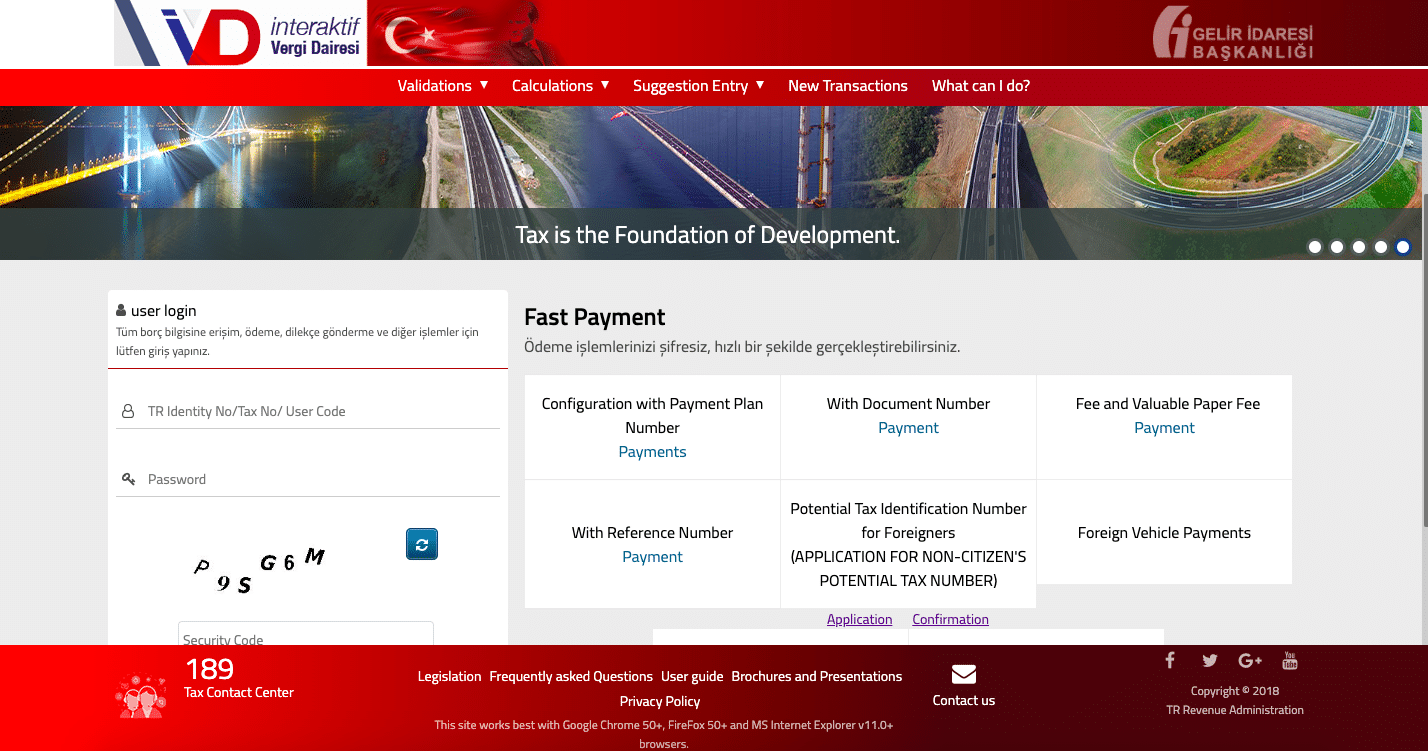
Tax identification number, tax office registration and *İnteraktif Vergi Dairesi* setup
Annual income tax returns, corporate tax returns and periodic VAT/withholding filings
Representation in tax audits, *uzlaşma* settlement meetings and Tax Court proceedings
Defence in tax offence prosecutions, including *VUK* Article 359 charges
Who Pays Tax in Turkey: Residency and Liability
Everything in Turkish tax starts here. The Income Tax Law No. 193 divides taxpayers into full taxpayers (*tam mükellef*) and limited taxpayers (*dar mükellef*), and the consequences are very different: a full taxpayer declares worldwide income in Turkiye, while a limited taxpayer declares only income sourced in Turkiye.
The residence and 183-day tests
You are treated as a full taxpayer if your legal residence (*ikametgâh*) is in Turkiye, or if you stay in Turkiye continuously for more than six months in a calendar year. The six-month test counts days, not intentions, and temporary absences do not automatically reset it.
The law also carves out exceptions: people who come to Turkiye for a specific, defined assignment, for education, medical treatment, or travel are not made resident by that stay alone. Whether your situation fits an exception is exactly the kind of point a tax inspector will test years later, so it is worth documenting at the time. Our guide to resident tax in Turkiye works through the practical fact patterns.
Full versus limited taxpayer in practice
For a limited taxpayer, the question becomes whether income is Turkish-sourced. Rent from a flat in Istanbul is; a salary paid abroad for work performed abroad generally is not. Turkish-source income of non-residents is frequently taxed at source through withholding, which can end the matter without any return being filed.
For a full taxpayer, foreign income comes into scope: foreign salary, foreign rent, foreign dividends and foreign capital gains. This is the single most common surprise for new arrivals, and it is also where treaty relief and Turkiye's newer foreign-income reliefs matter most.
When a treaty changes the answer
Turkiye has a wide double taxation treaty network. A treaty can allocate taxing rights to one state, cap the withholding rate on dividends, interest and royalties, and, where both states claim you as resident, apply tie-breaker tests based on permanent home, centre of vital interests, habitual abode and nationality.
Treaty relief is not automatic: it usually requires a residency certificate from the other state and a correctly taken filing position. See our guide to double taxation agreements, and for US-connected clients the Turkiye–U.S. treaty guide.
Personal Income Tax for Foreigners
Turkish personal income tax is charged on seven categories of income, at progressive rates that currently run from 15% in the lowest band to 40% in the top band. Employment income is normally taxed at source by the employer, which is why many employees never file a return; other categories usually require an annual declaration.
Employment and self-employment income
Salary paid by a Turkish employer is withheld monthly and rarely needs a return. Where you have more than one employer, income above the declaration threshold, or income paid from abroad into a Turkish tax residence, an annual return is likely to be required.
Independent professional income (*serbest meslek kazancı*) is declared annually and is subject to withholding when paid by businesses. Deductible expenses matter a great deal here: our note on deductible business expenses in Turkiye sets out what the tax office will and will not accept.
Rental income from Turkish property
Rent from Turkish real estate is Turkish-source income and is taxable whether or not you live in Turkiye. Residential rent benefits from an annual exemption amount and can be declared using either the lump-sum expense method or actual documented expenses; commercial rent paid by a business is usually subject to withholding instead.
Foreign owners routinely under-report here because the rent is paid abroad or in cash. That is the fact pattern audits are built on, and it interacts badly with the title deed value declared on purchase.
Investment income and gains
Dividends, interest, and gains on shares and property each have their own regime, and several of them are handled by final withholding rather than declaration. Property sold within five years of acquisition is generally within the scope of capital gains tax, while a sale after five years is generally outside it.
Companies resident in Turkiye are taxed on worldwide profit under Corporate Tax Law No. 5520; non-resident companies are taxed on Turkish-source profit, typically through a branch or a permanent establishment. The headline corporate income tax rate is 25%, rising to 30% for banks and financial institutions, with reduced rates available for certain exporters and manufacturers.
Corporate income tax and filing
Corporate taxpayers file quarterly advance (provisional) tax returns during the year and an annual corporate tax return after year end, with the advance tax already paid credited against the final liability. Transfer pricing, thin capitalisation and controlled foreign company rules all apply to cross-border groups and are checked on audit.
VAT (*KDV*) applies at a standard rate of 20%, with reduced 10% and 1% rates for listed goods and services, and is filed monthly. Stamp duty applies to a surprisingly wide range of signed documents, including many commercial contracts, and is a routine source of unexpected assessments.
If you import or export, customs duties and import taxes sit alongside VAT and are assessed at the border. Turkiye is in a customs union with the European Union, so goods in free circulation within the EU largely move duty-free, while goods originating elsewhere are dutiable: origin, tariff classification and customs valuation therefore decide the bill, and each of them is a recognised audit target. Special consumption tax (*ÖTV*) applies on top for vehicles, fuel, alcohol, tobacco and certain electronics.
Turkiye runs an extensive incentive system: investment incentive certificates, technology development zones, free trade zones, and the reliefs introduced by the 2026 package. Targeted sectors (R&D, energy, manufacturing and export-oriented activity) attract the deepest allowances, and small and medium-sized enterprises qualify for reliefs that larger groups do not. These can change the effective rate dramatically, but each carries its own qualifying tests and clawback risk.
Owning assets in Turkiye creates its own standing tax obligations, separate from income tax. On purchase, a title deed fee of 4% of the declared value applies, conventionally split between buyer and seller. Thereafter, annual property tax (*emlak vergisi*) is assessed by the municipality at rates that vary by property type and by whether the municipality is metropolitan.
Vehicles attract annual motor vehicle tax; businesses with an address in a municipality attract environmental cleaning tax; and transfers on death attract inheritance and gift tax at progressive rates, with a tax clearance certificate required before the title deed can be transferred to heirs.
Before you can pay Turkish tax you need to exist in the system. Foreign nationals obtain a tax identification number, for most purposes the foreigner identity number now serves this role, which is required to open a bank account, buy property, register a company or file anything at all.
Filing then runs on a fixed calendar rather than on your anniversary: the annual personal income tax return is filed in March for the previous calendar year and paid in two instalments, corporate returns follow after year end, and VAT and withholding returns are periodic. Missing a date does not merely delay matters; it triggers late payment interest and, in many cases, an automatic penalty.
This is where most of our tax work actually happens. A Turkish tax dispute rarely starts with litigation; it starts with a letter, an information request, or an inspection report, and the decisions you take in those first weeks largely determine the outcome.
Tax Procedure Law No. 213 sets out both the assessment machinery and the penalty regime. An underpayment normally attracts a *vergi ziyaı* penalty equal to the tax lost, rising to three times where the conduct falls within the tax offences in Article 359, alongside procedural penalties and late payment interest.
Correction and settlement (uzlaşma)
Many assessments can be resolved administratively. A request for correction addresses clear factual or calculation errors. Settlement, available both before an assessment is formally issued (*tarhiyat öncesi*) and after (*tarhiyat sonrası*), allows the tax and, importantly, the penalty to be negotiated down, and a settled file is closed for good.
Settlement is a strategic choice, not a default. Accepting it waives the right to litigate, so it should only be taken once the strength of the underlying position has been assessed.
Tax Court litigation and appeals
Where settlement is not appropriate, an action is brought before the Tax Court, generally within 30 days of notification. Filing suit suspends collection of the disputed assessment in most cases, which is often reason enough to litigate rather than pay under protest.
Tax Court decisions are appealable to the Regional Administrative Court (*istinaf*) and, for qualifying matters, onward to the Council of State (*Danıştay*). We appear at each stage and handle the interaction with the tax office in parallel.
Penalties and tax offences
Not every tax problem stays administrative. Issuing or using false documentation, keeping a second set of books, or destroying records fall under Article 359 of the Tax Procedure Law and are prosecuted as criminal offences carrying imprisonment, separately from the tax assessed.
If you have received anything that mentions Article 359 or a *naylon fatura* allegation, treat it as urgent, see fake invoice crime and VUK 359 penalties, and take advice before responding to the inspector.
Our Process (Step by Step)
1
Initial Consultation and Position Review
We start with the facts that decide everything: where you live, how many days you spend in Turkiye, where your income arises, and what you have already filed or received. You leave the call knowing whether Turkiye can tax you and what the exposure looks like.
2
Residency and Treaty Analysis
We determine your taxpayer status under the Income Tax Law, test it against any applicable double taxation treaty, and set out the filing position we can defend: in writing, before anything is submitted.
3
Registration and Documentation
We obtain your tax identification number, register you or your company with the correct tax office, gather residency certificates and supporting records, and set up online access so filings can be handled remotely.
4
Filing and Payment
We prepare and submit the returns due, calculate the liability and instalments, and confirm payment. Where a relief or exemption applies, we document the basis for it so it survives a later inspection.
5
Audit Defence and Dispute Resolution
If the tax office opens an inspection or issues an assessment, we respond to the inspector, attend settlement meetings, and where necessary bring proceedings in the Tax Court within the appeal deadline.
6
Ongoing Compliance
We keep you on the calendar (periodic returns, annual declarations, changes in your day count or residence status) so the next year does not become the next dispute.
Why Choose Bayraktar Attorneys
Foreigner-focused
We act almost exclusively for foreign individuals and international businesses, in English, and we are used to explaining Turkish tax concepts to people whose home system works differently.
Advisory and litigation together
The same team that takes the filing position defends it. That matters: positions taken for convenience at filing are the ones that fail on audit.
Handled under power of attorney
Registration, filings, tax office correspondence and most dispute steps can be carried out without you travelling to Turkiye.
Joined up with your other matters
Tax rarely arrives alone. Our corporate, real estate, inheritance and immigration teams work from the same file, so a property purchase or a residence permit does not create a tax problem nobody looked at.
NB
Atty. Nevzat Oğulcan Bayraktar
Founding Attorney · Istanbul Bar Association. View profile →
Frequently Asked Questions
Generally yes if your legal residence is in Turkiye, or if you stay in Turkiye continuously for more than six months (183 days) in a calendar year. There are statutory exceptions for stays tied to a specific assignment, education, medical treatment or travel. If both Turkiye and your home country treat you as resident, a double taxation treaty tie-breaker decides which one wins.
If you are a full taxpayer, your worldwide income falls within scope in principle: foreign salary, rent, dividends and gains included. Whether Turkiye actually taxes it depends on the applicable treaty, on foreign tax credits, and on any specific relief you qualify for. If you are a limited taxpayer, only Turkish-source income is taxed.
Personal income tax is progressive, with bands running from 15% at the bottom to 40% at the top. The band thresholds are revised each year. Certain income types, including many forms of investment income, are instead taxed by final withholding at their own rates rather than through the progressive scale.
The standard corporate income tax rate is 25%, and 30% for banks and financial institutions. Reduced rates apply to certain exporters and manufacturers, and further reductions are available under investment incentive certificates and in special zones.
Foreign nationals holding a Turkish foreigner identity number generally use that number for tax purposes. Those without one obtain a tax identification number from a tax office or online, using a passport. You will need it before you can open a bank account, buy property, set up a company or file a return, and we routinely obtain it under power of attorney.
The annual personal income tax return is filed in March for the previous calendar year, with the tax payable in two instalments. Corporate taxpayers file quarterly advance tax returns and an annual return after year end. VAT and withholding returns are filed periodically through the year. Missing a deadline triggers late payment interest and, usually, a penalty.
You have options, but they are time-limited. Clear errors can be corrected administratively. Settlement (uzlaşma) is available before or after the assessment is issued and can reduce both the tax and the penalty, but accepting it waives your right to litigate. Otherwise you can bring an action in the Tax Court, generally within 30 days of notification, which in most cases suspends collection while the case runs.
Yes. Registration, filings, correspondence with the tax office, settlement meetings and Tax Court proceedings can all be handled under a power of attorney. We work in English and report in writing, so you can run a Turkish tax position from abroad.
Contact us
Contact our office to describe your enquiry and request information about the relevant procedure and documents.
This page provides general information about tax law in Turkey and does not constitute legal advice. For guidance on your specific situation, please contact Bayraktar Attorneys for a consultation.