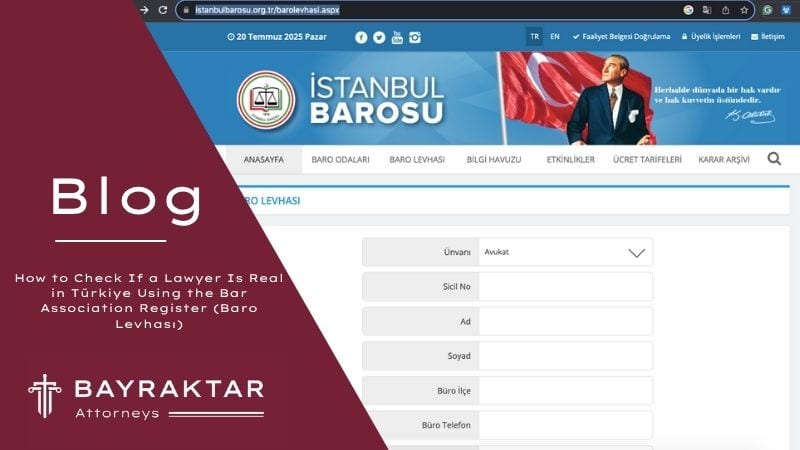
Quick answerTo verify a lawyer in Türkiye, search the baro levhası, the register kept by the bar the lawyer belongs to. On the Istanbul Bar site (istanbulbarosu.org.tr/levha) you can search by registration number, first name or surname; the result shows the registration number, name, title, office district and office telephone. Under Articles 35 and 63 of the Attorneyship Law, Law No. 1136, only lawyers on a bar register may represent clients or use the title Avukat. Call the office number in the register, not the one you were given, and report a fake lawyer to the prosecutor and the bar.
Foreigners who need a lawyer in Türkiye usually find one online, through a property agent or through a friend, and then pay a retainer before ever seeing an office. That is exactly the gap that fake lawyers exploit. Some invent a name, others copy the name and registration number of a real lawyer and attach their own phone number, email address or WhatsApp account. The good news is that every practising lawyer in Türkiye must be entered on the register of a provincial bar, and that register can be searched in a few minutes. The rules behind it are in the Attorneyship Law, Law No. 1136, whose disciplinary chapter was substantially rewritten by Law No. 7571 of 24 December 2025, which now expressly penalises lawyers who let others use their identity or who persistently solicit clients online. This article explains what the register is, how to search it, what the result does and does not prove, how to check a law partnership, a foreign lawyer and a power of attorney, and what to do if you have already been defrauded.
1. Why Checking a Lawyer's Registration Matters
1.1 Only Registered Lawyers May Practise Law
Under Article 35 of Law No. 1136, giving legal opinions, bringing and defending claims before courts and arbitrators, following legal proceedings and drafting the documents for them are reserved to lawyers registered with a bar. Anyone with legal capacity may conduct their own case, but nobody else may do these things for you unless they are on a bar register. Article 63 adds that persons not entered on a baro levhası, the register of lawyers kept by each bar association, may not prepare case documents for others, conduct enforcement proceedings or use any of the powers of a lawyer, and may not use the title "Avukat" at all. The same applies to a lawyer who has been suspended from practice.
1.2 What Happens to People Who Pretend
Article 63 provides for an administrative fine imposed by the public prosecutor on anyone who acts as a lawyer without registration, and for imprisonment of one to three years and a judicial fine for those who exercise a lawyer's powers through sham assignments of claims. Courts, enforcement offices and bars that learn of such conduct must report it to the prosecutor. Where money has been taken, the conduct is usually also fraud under the Turkish Penal Code, Law No. 5237, discussed in section 10 below. None of this helps much once your money has gone abroad, which is why the check should come before the first payment.
2. Who Can Be a Lawyer: Admission and the Baro Levhası
2.1 Admission Conditions Under Article 3
Article 3 of Law No. 1136 sets the conditions for admission: Turkish citizenship, a law degree from a Turkish faculty (or a foreign law degree completed by examinations in the missing Turkish subjects), completion of the traineeship with a completion certificate, residence in the region of the bar whose register the applicant wishes to join, and the absence of any bar to practice under the Law. Article 5 excludes, among others, persons convicted of fraud, forgery or breach of trust. The citizenship condition matters for foreigners: a foreign national cannot be admitted as a Turkish lawyer, which is why the rules on foreign lawyers in section 7 are so narrow.
2.2 The Licence and the Role of Article 8
The bar's board of directors decides on an application for entry on its register. Under Article 8, that decision is sent to the Union of Turkish Bar Associations, Türkiye Barolar Birliği (TBB), the national umbrella body, within 15 days and then to the Ministry of Justice for approval; refusals can be challenged before the Union within 15 days of notification. Article 9 states that admission takes effect only when the bar hands over the ruhsatname, the lawyer's licence, and that only from then may the person use the title "Avukat". A law graduate who is still a trainee, stajyer, is therefore not yet a lawyer, even though trainees also appear in the bar's database.
2.3 Which Bar a Lawyer Belongs To
Article 66 requires each lawyer to join the register of the bar for the place where they practise permanently; where a province has more than one bar, the lawyer joins one of them. Istanbul, for example, now has the Istanbul Bar and the Istanbul No. 2 Bar. Once registered, a lawyer may also act anywhere in Türkiye, provided it is not on a permanent basis, so an Istanbul lawyer handling a case in Antalya is entirely normal. What is not normal is a person who cannot tell you which bar they belong to.
3. How to Search the Istanbul Bar Register
3.1 The Search Form
The Istanbul Bar, the largest bar in the country, publishes its register at istanbulbarosu.org.tr/levha under the heading "Baro Levhası". The form has four fields: title (Avukat for lawyers or Stajyer for trainees), registration number (at least three digits), first name and surname. One field is enough. Leave the title on "Avukat" when you are checking someone who claims to be a lawyer.
3.2 What the Result Shows
When we tested the search in November 2026, each result showed five items: registration number, full name, title, the district of the office and the office telephone number. It does not show a full street address, an email address, a website or the date of admission. That makes the telephone number and district the most useful items: if the person you are dealing with gives a different number, call the number in the register and ask whether the lawyer is in fact handling your matter.
3.3 If the Name Does Not Appear
Turkish letters cause many false negatives. Try the surname alone, then with and without Turkish characters (ı and i, ş and s, ğ and g, ö and o, ü and u, ç and c). If there is still no result, ask the person for their bar and registration number and search by number. A lawyer who is struck off under Article 72 (for example for failing to keep an office in the bar's region or for leaving the profession) or disbarred under Article 135 should no longer appear. When in doubt, contact the bar directly using the telephone number on its own website, never a number supplied by the person you are checking.
| What to check | How to check it |
|---|
| Is the person a lawyer? | Search the register of the bar they name, with the title set to Avukat |
| Is the phone number genuine? | Compare it with the office telephone shown in the register |
| Which bar? | Ask for the bar and registration number and search by number |
| Lawyer identity card | Compare name, photograph and bar on the card with the register entry |
| Document issued by the Istanbul Bar | Use the bar's document verification page with the barcode number |
| Law partnership | Check that the name ends in "Avukatlık Ortaklığı" and that each partner is on a register |
| Foreign law firm | Confirm it advises only on foreign and international law (Article 44/B) |
| Power of attorney | Notary or consulate issued; check scope and, with e-Devlet access, the notarial records |
4. Other Bars and the Union of Turkish Bar Associations
Every provincial bar, from Ankara and Izmir to Antalya and Muğla, keeps its own register and many publish a search page on their websites, usually under "Baro Levhası" or "Avukat Arama". The fields and the information displayed differ from bar to bar, so do not assume that a missing item (for example a telephone number) is suspicious in itself. The Union of Turkish Bar Associations, whose official website is barobirlik.org.tr, prints the licences and identity cards and receives notice of every admission. One practical warning: the address tbb.org.tr, which is sometimes given as the Union's website, belongs to the Banks Association of Türkiye, not to the bar. For a definitive answer about an individual lawyer, the register of the bar where that lawyer is enrolled remains the primary source.
5. Registration Number, Identity Card and Bar Documents
5.1 The Lawyer Identity Card
Article 9 provides that licences and lawyer identity cards are printed and issued in a single format by the Union, and that the lawyer identity card counts as an official identity document accepted by all public and private institutions. The Union's Attorneyship Law Regulation, Article 13, confirms that the card is an official document. A genuine lawyer has no reason to refuse to show it at a meeting. Forging such a card, or using a forged one, may be prosecuted as forgery of an official document under Article 204 of Law No. 5237, punishable by two to five years' imprisonment.
5.2 Documents With a QR Code
The Istanbul Bar issues documents through an electronic document system, and its "Belge Doğrulama" page (istanbulbarosu.org.tr/belgedogrulama) lets institutions verify a QR coded document with the Turkish identity number and the barcode number. If someone sends you a "bar certificate" with a barcode, ask a Turkish lawyer you trust, or the bar itself, to run it through that page. A certificate that cannot be verified should be treated as false until proven otherwise.
6. Law Firms: Avukatlık Bürosu and Avukatlık Ortaklığı
Turkish lawyers cannot practise through ordinary trading companies, a point we explain in why Turkish lawyers cannot form corporate law firms. Article 44 of Law No. 1136 allows only two structures. In a shared office, lawyers registered with bars in the same province work together without legal personality and must use the words "Avukatlık Bürosu" next to the name of one or more of them. An avukatlık ortaklığı, a law partnership with legal personality, is formed by lawyers registered in the same province and gains legal personality only when the bar enters it on the Baro Avukatlık Ortaklığı Sicili, the bar's register of law partnerships. Its name must consist of one or more partners' names followed by "Avukatlık Ortaklığı". Powers of attorney are issued in the partnership's name, and the partnership is jointly and severally liable with its partners and employed lawyers.
In practice this gives you two simple tests. A business calling itself a "law company", "legal consultancy Ltd" or similar is not a law firm in the Turkish sense and cannot represent you in court. And if a firm does use "Avukatlık Ortaklığı", each named partner should appear on a bar register; you can also ask the bar to confirm the partnership's registration.
7. Foreign Lawyers and Foreign Law Consultancy
Because Article 3 requires Turkish citizenship, a lawyer qualified in another country cannot appear in Turkish courts. Article 44/B allows foreign law partnerships to operate in Türkiye under the foreign investment rules only if they are set up in accordance with Law No. 1136 and the partnership rules, and only to advise on foreign law and international law. That limitation also covers the Turkish and foreign lawyers working for them; their partners need not be on a Turkish bar register, and the whole arrangement depends on reciprocity. Breach of these limits is subject to a disciplinary fine under Article 135, set in the law at 20,000 to 200,000 Turkish Lira and revalued every year. So a foreign adviser may legitimately explain your home country's law or coordinate a cross border matter, but any filing, hearing or Turkish law opinion has to come from a lawyer on a Turkish register.
8. Warning Signs of a Fake Lawyer or Scam
8.1 Impersonation of Real Lawyers
The most effective scams use a real lawyer's name and registration number, so the register search succeeds. The difference lies in the contact details: a mobile number, a webmail address or a messaging profile that does not match the office telephone in the register. Ask for a video call from the office, call the register number yourself, and be wary if the "lawyer" can never meet you at the office registered with the bar. Article 51 requires lawyers to take instructions and give legal advice at their registered office, except where they are specifically called elsewhere.
8.2 Payment and Communication Red Flags
- Pressure to pay immediately, to a personal account abroad, in cryptocurrency or in cash without a receipt. Article 236 of the Tax Procedure Law, Law No. 213, requires self employed professionals to issue a receipt (serbest meslek makbuzu) for every payment.
- Guaranteed outcomes such as "citizenship in 30 days" or "case won for sure". Turkish lawyers cannot promise results, and fee agreements must respect the ceiling and minimum rules in Articles 163 and 164, explained in our guide to attorney fees in Türkiye.
- Refusal to give a written engagement letter stating the work and the fee.
- Unsolicited, repeated messages offering legal services. Advertising is banned under Article 55, and since Law No. 7571 persistent online solicitation is expressly listed as grounds for a reprimand.
- "Court documents" or "UYAP printouts" sent as screenshots demanding a fee to release funds or close a file.
8.3 Touts and Recovery Scams
Article 48 punishes, with six months to one year of imprisonment, anyone who brings clients to a lawyer in exchange for a fee or benefit, and the lawyer who uses such intermediaries. Foreigners meet these touts outside courthouses, police stations and removal centres. A second pattern targets people who have already lost money: a "lawyer" or "recovery agency" promises to retrieve the funds for an upfront fee. A genuine lawyer will first ask for the documents, explain the realistic options and put the fee in writing.
9. Checking a Power of Attorney
9.1 Form
Under Article 76 of the Code of Civil Procedure, Law No. 6100, a lawyer must file in each case the original power of attorney drawn up or certified by a notary, or a copy certified by the lawyer. Article 56 of Law No. 1136 gives such lawyer certified copies the status of official copies, and certifying a copy of a power of attorney that does not exist is punishable by three to six years' imprisonment. If you are abroad, the power is signed before a Turkish consulate or before a local notary with an apostille; our article on the power of attorney in Türkiye covers the steps.
9.2 Scope
Read the scope before signing. Article 74 of Law No. 6100 lists acts a lawyer may perform only with express authority, including settlement, waiver of the claim and release of the other side. Under Article 504 of the Turkish Code of Obligations, Law No. 6098, an agent may not transfer or encumber immovable property, make donations or stand as surety without special authority. A "litigation" power that also authorises selling your apartment or collecting all payments should be questioned.
9.3 Verification and Revocation
Holders of e-Devlet access can use the Notaries' Union service "Kişi Vekaletnameleri Sorgulama" to view powers of attorney recorded in their name; notarial documents can also be checked through the Notaries' Union document verification service. Under Article 512 of Law No. 6098 you may revoke a mandate at any time, subject to compensation if revocation is untimely. The procedure is set out in our guide to the azilname, the revocation of a power of attorney.
10. What to Do If You Were Defrauded
10.1 Criminal Complaint
Article 158 of the Code of Criminal Procedure, Law No. 5271, allows a complaint to be made to the Chief Public Prosecutor's Office or the police, in writing or orally; offences committed abroad that must be prosecuted in Türkiye may also be reported to Turkish embassies and consulates. Fraud under Article 157 of Law No. 5237 carries one to five years' imprisonment; Article 158 raises this to three to ten years where, among other cases, a self employed professional abuses the trust placed in them, or public professional organisations are used as an instrument, and increases it further when three or more people act together. Our guide on filing a fraud complaint in Türkiye explains the documents to bring. If the prosecutor decides not to prosecute, you may object within two weeks of notification to the criminal judgeship of peace (Article 173), and once a case opens you may join it as an intervening party (Article 237).
10.2 Bar Complaint and Disciplinary Process
If the person is a real lawyer who took your money and did nothing, complain in writing to the bar where the lawyer was registered when the complaint was made (Article 139). The board must decide within one year at most (Article 141); a decision not to open proceedings can be challenged by the complainant before the Union's board within 15 days of notification (Article 142), and decisions of the disciplinary board can be challenged within 30 days before the Union's disciplinary board (Article 157). Under Article 159, no proceedings may begin once three years have passed since the act unless the board has already taken up the matter, and no penalty may be imposed after four and a half years, unless the act is also a crime with a longer limitation period. Offences a lawyer commits in the course of duty are investigated only with Ministry of Justice permission (Article 58), as described in our article on the investigation and prosecution of lawyers in Türkiye.
| Disciplinary penalty (Article 135) | What it means |
|---|
| Uyarma (warning) | Written notice to act with more care |
| Kınama (reprimand) | Written finding of fault; includes letting others use a lawyer's identity and keeping client money |
| Para cezası (fine) | 20,000 to 200,000 Turkish Lira in the law, revalued annually, paid to the bar |
| İşten çıkarma (suspension) | Ban on practice for three months to two years |
| Meslekten çıkarma (disbarment) | Licence withdrawn and name removed from the register |
10.3 Getting the Money Back
A disciplinary decision does not order repayment. Recovery requires a claim for damages under Article 49 of Law No. 6098 or for return of the fee, often supported by a precautionary attachment under Article 257 of the Enforcement and Bankruptcy Law, Law No. 2004, where the debtor is hiding assets or has no fixed domicile. Act quickly, keep every message, receipt and bank transfer record, and have the case handled by a lawyer experienced in criminal law services who can run the criminal and civil routes together. For choosing a lawyer more generally, see our guide to finding an English speaking lawyer in Türkiye.
11. Frequently Asked Questions
11.1 Is searching the baro levhası possible without a Turkish ID number?
Yes. The Istanbul Bar search asks only for a registration number, first name or surname, and no login or identity number is needed.
11.2 What does the Istanbul Bar search result show?
It shows the registration number, full name, title (lawyer or trainee), office district and office telephone number; it does not show an email address or full office address.
11.3 The lawyer is real, but the phone number differs. What should I do?
Call the office number from the register and ask whether that lawyer is handling your matter before you pay or send documents, because copying a real lawyer's identity is a common scam.
11.4 Can a lawyer registered in Istanbul act for me in another city?
Yes. Under Article 66 of Law No. 1136 a registered lawyer may work anywhere in Türkiye, provided it is not on a permanent basis.
11.5 Is a trainee lawyer (stajyer) a lawyer?
No. Admission takes effect only when the licence is issued under Article 9, so a trainee cannot use the title "Avukat".
11.6 Can a foreign lawyer represent me in a Turkish court?
No. Admission requires Turkish citizenship under Article 3, and foreign law partnerships may advise only on foreign and international law under Article 44/B.
11.7 Is a "legal consultancy" limited company a law firm?
No. Lawyers may only work alone, in a shared office or through an "Avukatlık Ortaklığı" registered with the bar, and only registered lawyers may give legal opinions or represent clients.
11.8 How do I check a law partnership?
Its name must end in "Avukatlık Ortaklığı", each partner should appear on a bar register, and the bar keeps the partnership register in which the firm must be entered.
11.9 Should a lawyer give me a receipt?
Yes. Article 236 of Law No. 213 requires a serbest meslek makbuzu for every payment received by a self employed professional, including lawyers.
11.10 Where do I report a fake lawyer?
To the Chief Public Prosecutor's Office or the police under Article 158 of Law No. 5271, and also to the bar whose name or member was used.
11.11 Can I complain from abroad?
Yes. Offences committed abroad that must be prosecuted in Türkiye can be reported to a Turkish embassy or consulate, and a lawyer in Türkiye can file a complaint for you under a power of attorney.
11.12 Is there a deadline for a bar complaint?
Disciplinary proceedings cannot start more than three years after the act unless the board has already taken up the matter, and no penalty can be imposed after four and a half years, unless the act is also a crime with a longer limitation period.
11.13 Will the bar refund my money?
No. The bar can only impose disciplinary penalties; repayment requires a civil claim or a claim in the criminal proceedings.
11.14 How can I see which powers of attorney I have given?
With e-Devlet access you can use the Notaries' Union service "Kişi Vekaletnameleri Sorgulama"; otherwise ask the notary that drew up the document.
12. Conclusion
Every lawyer in Türkiye must be on a bar register under Law No. 1136, and only registered lawyers may give legal opinions, represent clients or draft legal documents for them. A few minutes on the bar's register, a call to the office number shown there, a look at the identity card and a careful reading of the power of attorney will stop most scams aimed at foreigners. If something has already gone wrong, the criminal complaint, the bar complaint and a civil claim each have their own deadlines and should be started without delay.
If you would like us to check a lawyer, a law firm or a power of attorney before you sign, or need to act after paying someone who turned out not to be a lawyer, our legal team can review the documents and explain the options available under Turkish law.