Quick answerAs of 28 September 2026, GEDAŞ is no longer the only company allowed to prepare valuation reports for Turkish citizenship by investment. Following a Ministry of Environment, Urbanization and Climate Change decision (No. 21900458, 18 September 2026), any valuation company holding an SPK licence, active TDUB membership, and TADEBİS registration can now prepare the report. The USD 400,000 minimum investment threshold is unchanged.
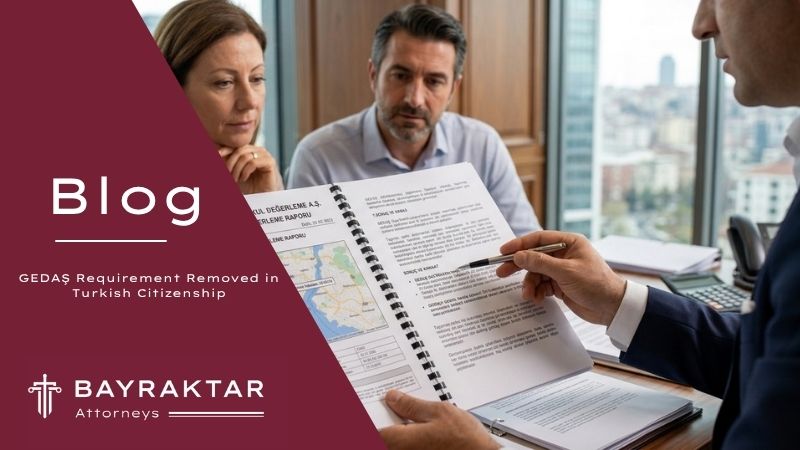
For eighteen months, every foreign national pursuing Turkish citizenship through the real estate route had to use a single valuation company. On 28 September 2026, that changed. The Directorate General of Land Registry and Cadastre (Tapu ve Kadastro Genel Müdürlüğü, "TKGM") issued a Makam Oluru (Office Directive) updating Circular No. 2024/2, ending GEDAŞ's exclusive authority over citizenship-purpose valuation reports and reopening the field to every valuation company licensed by the Capital Markets Board.
Quick answer: As of 28 September 2026, applicants for Turkish citizenship by real estate investment are no longer required to use GEDAŞ (Gayrimenkul Değerleme A.Ş.) for their valuation report. Any valuation company holding an SPK licence, active membership in the Turkish Valuation Experts Association (TDUB), and registration in the Real Estate Valuation Information System (TADEBİS) may now prepare the report. The change follows a decision of the Ministry of Environment, Urbanization and Climate Change dated 18 September 2026 (No. 21900458). The USD 400,000 minimum investment threshold is unchanged.
1. What changed on 28 September 2026
The legal basis for the change is a decision of the Ministry of Environment, Urbanization and Climate Change dated 18 September 2026, numbered 21900458, which authorised valuation reports used for determinations under the Turkish Citizenship Law Implementation Regulation to be prepared by any SPK-licensed valuation institution, not only GEDAŞ. TKGM gave effect to that decision the same month with a Makam Oluru updating Circular No. 2024/2: the same circular that had granted GEDAŞ its exclusive mandate in the first place.
Practically, this means the applicant, or their attorney, can once again choose which licensed valuation company prepares the report supporting a citizenship-by-investment file, rather than being routed to a single state-linked provider.
2. Why GEDAŞ became the only option in 2024
To understand why this matters, it helps to remember why the restriction existed at all. Before March 2024, applicants could use any SPK-licensed appraiser, and the system had a well-documented weakness: some valuation reports were quietly inflated to make an under-priced property look like it met the USD 400,000 threshold, or a genuine sale was overstated on paper while a much smaller sum actually changed hands. Türkiye's 2025 citizenship fraud investigation (which uncovered roughly 1,198 fake applications and an estimated USD 181.2 million in fabricated or diverted capital) traced a meaningful share of that fraud back to exactly this weak point: a valuation report that did not reflect the property's real value or the real cash that moved.
TKGM's response, effective 4 March 2024 under Circular No. 2024/2, was blunt but effective: hand exclusive authority for citizenship-purpose appraisals to GEDAŞ, a valuation company under the umbrella of TOKİ (Türkiye's Housing Development Administration). With one state-linked gatekeeper and no competition, the market for inflated citizenship appraisals largely disappeared, but so did the applicant's ability to choose their own appraiser, and GEDAŞ's turnaround times became a genuine bottleneck for a program that depends on speed.
3. The new requirements: SPK, TDUB and TADEBİS
The September 2026 update does not return to the pre-2024 free-for-all. A valuation company preparing a citizenship report must now meet three conditions at once:
- SPK licence: formal authorisation from the Capital Markets Board (Sermaye Piyasası Kurulu) to carry out real estate valuation activity.
- Active TDUB membership: the company and its responsible valuation expert must be active members of the Turkish Valuation Experts Association (Türkiye Değerleme Uzmanları Birliği).
- TADEBİS registration: the company must be registered in the Real Estate Valuation Information System (Taşınmaz Değerleme Bilgi Sistemi), the digital registry through which valuation reports are now tracked.
This is the structural reason the reform is safe to make: valuation reports produced by any of these companies are routed through the same digital infrastructure, connected to Web Tapu and cross-checked against the land registry file, that was built out after 2024 specifically to stop a report's figures from being altered between preparation and submission. GEDAŞ's monopoly was one way to close the fraud gap; a shared, auditable digital trail across every licensed, TDUB-member, TADEBİS-registered company is another, and it no longer requires funnelling every applicant through a single office.
4. What has not changed
It is worth being precise about the limits of this reform, because overstating it creates real risk for an applicant relying on it:
- The USD 400,000 threshold is unchanged. A property (or combination of properties) must still be valued at no less than USD 400,000 for the real estate route to Turkish citizenship by investment, and if the valuation comes in below that figure, the file is rejected regardless of the contract price.
- The three-year resale restriction is unchanged. The title deed annotation preventing resale for three years from acquisition still applies; see our guide on removing the 3-year annotation for how and when it lifts.
- Report validity rules are unchanged. A valuation report remains valid for twelve months from issue, and must be renewed if the property's status changes in the meantime: a change of use, a partial expropriation for road widening ("yola terk"), or a similar registered change.
- TKGM's own review is still formal, not substantive. The Directorate checks that the report is complete and properly issued; it does not re-verify the valuation figure itself. Responsibility for the accuracy of the report, and liability if it turns out to be wrong, rests with the valuation company and the expert who signed it, not with TKGM.
- Not every appraiser qualifies. A generic SPK licence alone is not enough; the TDUB membership and TADEBİS registration conditions are cumulative, not optional. An applicant who is handed a report from a company that fails either test risks having the file rejected on a technicality that has nothing to do with the property's actual value.
5. What this means for investors applying now
For an investor with a file open today, or about to open one, the practical effect is choice. GEDAŞ's exclusivity had become one of the more common causes of delay in an otherwise well-prepared file: a single institution serving every citizenship-linked valuation nationwide inevitably builds a queue. Being able to instruct any qualifying SPK-licensed, TDUB-member, TADEBİS-registered valuation company again means an applicant's attorney can select a firm based on turnaround time and availability rather than accept whatever slot GEDAŞ offers.
It does not mean shopping for the most generous number. A report that overstates a property's value to clear the USD 400,000 line is exactly the pattern that triggered the 2024 restriction and the 2025 fraud investigation in the first place, and TADEBİS's digital trail makes an inflated report considerably easier to trace back to its author than it was before 2024. Our own approach for clients has not changed with this reform: we work only with valuation companies whose figures we are confident will hold up under scrutiny, because a report that collapses on review does not just delay a file, under Article 31 of Law No. 5901, it can expose the applicant to annulment of citizenship already granted.
What about applications already in progress?
Nothing in the September 2026 update suggests that valuation reports already prepared by GEDAŞ under the old rule are affected: a report issued while the GEDAŞ requirement was in force remains a GEDAŞ report, validly obtained under the rule that applied at the time, and there is no indication TKGM intends to require it to be redone. Where a file is mid-process and a GEDAŞ report is pending rather than issued, the applicant now has the option to instruct a different qualifying valuation company instead, which may be the faster route depending on GEDAŞ's current queue. Anyone with an open file should confirm the current status with their attorney before assuming either path is automatically the quicker one.
6. How to choose a valuation company for your citizenship application
Given that eligibility now rests on three separate conditions rather than a single named institution, we recommend applicants, or their attorneys, verify, before instructing any valuation company, that it currently holds:
- a valid SPK licence for real estate valuation activity;
- active (not lapsed or suspended) membership in TDUB; and
- an active registration in TADEBİS under the same corporate name that will appear on the report.
A company that meets all three but has no track record with citizenship-purpose reports specifically is a different risk from one that is simply unlicensed, but for a USD 400,000 investment tied to citizenship status, we still recommend using a firm with demonstrated experience in citizenship valuations rather than a generalist appraiser, regardless of which of the two categories they fall into.
How Bayraktar Attorneys can help
At Bayraktar Attorneys, we instruct valuation companies on behalf of our citizenship-by-investment clients as part of a fully supervised file: checking SPK, TDUB and TADEBİS status before instruction, reviewing the resulting valuation report against the underlying sale, and sequencing it correctly within the wider citizenship by investment timeline. If you have a file open with GEDAŞ, or are starting a new application and want to know which valuation company can move quickest for your property, our team can advise on the current landscape and handle the instruction directly.
Frequently asked questions
Do I still need a valuation report for Turkish citizenship by investment?
Yes. Nothing about the requirement for a valuation report has changed, only who is allowed to prepare it. Every real-estate-route citizenship application still needs a report confirming the property meets the USD 400,000 threshold.
Is GEDAŞ no longer allowed to issue citizenship valuation reports?
GEDAŞ can still prepare reports; it simply lost its exclusivity. It remains one of the qualifying SPK-licensed, TDUB-member, TADEBİS-registered valuation companies; it is just no longer the only one.
What happens if my valuation company is SPK-licensed but not a TDUB member?
The report is likely to be rejected. The September 2026 update requires all three conditions together (SPK licence, active TDUB membership, and TADEBİS registration) not an SPK licence alone.
Does this change the USD 400,000 investment threshold?
No. The minimum investment amount for the real estate route to Turkish citizenship is unchanged at USD 400,000, and a report valuing the property below that figure still results in rejection regardless of the contract price.
How long is a valuation report valid for a citizenship application?
Twelve months from the date of issue, and it must be renewed sooner if the property's registered status changes, for example a change of use or a partial expropriation.
Can I use my own preferred appraiser if my file was already assigned to GEDAŞ?
If the GEDAŞ report has already been issued, it remains valid and there is no indication it needs to be redone. If it is still pending, you can generally now instruct a different qualifying valuation company instead: confirm the specifics of your file with your attorney first.