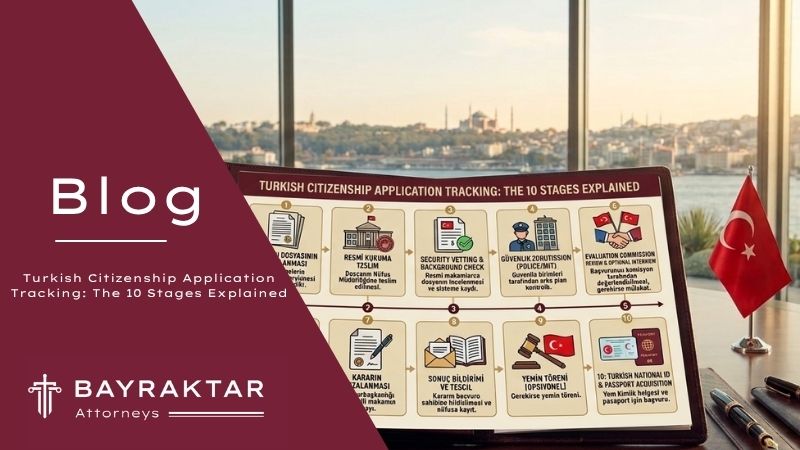
Quick answerTurkish citizenship applicants can check their file's status anytime at tckimlik.nvi.gov.tr using only their application number and date of birth, which displays one of ten sequential stages from initial e-Citizenship registration through final population registry entry. On average the process takes about one year, with a realistic range of six months to two years: investment-based applications tend to move fastest, while marriage-based files typically take twelve to eighteen months.
Anyone who has applied for Turkish citizenship, whether through marriage, through investment, or through five years of lawful residence, eventually arrives at the same question: what is actually happening to my file right now. Türkiye's Directorate General of Population and Citizenship Affairs, NVİ, answers that question through an official online tracking system, and this guide walks through exactly what each stage of that system means, how long the process realistically takes depending on which route you applied through, and what to do if your file appears stuck.
Quick Answer: Turkish citizenship applicants can check their file's status at any time through the official portal at tckimlik.nvi.gov.tr, using only their application number and date of birth. The system displays one of ten sequential stages, from initial registration in the e-Citizenship System through to final registration in the population registry and the requirement to apply in person to receive formal notification of the outcome. On average, a Turkish citizenship application takes around one year from filing to a final decision, though the realistic range runs from about six months to two years depending on the route, and a file that has run past two years is generally considered to be taking longer than typical. Investment based applications tend to move fastest overall, marriage based applications commonly resolve within twelve to eighteen months, and applications based on five years of residence, while often the slowest to begin with, can move very quickly once the file has been included in the list sent to the Decision Making Authority.
1. How to Check Your Turkish Citizenship Application Status
1.1 The Official Tracking Portal
The Directorate General of Population and Citizenship Affairs operates a dedicated online query tool at tckimlik.nvi.gov.tr, under the Vatandaşlık Başvuru Durumu Sorgula, Citizenship Application Status Inquiry, module. This is the authoritative source for checking a file's current stage, and it is free to use.
1.2 What You Need to Check Your Status
The system requires only two pieces of information: the application number assigned to your file when it was first submitted, and your date of birth. There is no need to create an account or log in with any other credentials specifically for this query, though the same information can generally also be accessed through Türkiye's e-Devlet portal, which routes to the same underlying NVİ system.
1.3 Keep Your Application Number Somewhere Safe
The application number is generated at the point of submission and is typically provided on the receipt or acknowledgment document given at that time. Applicants who submitted their file through a lawyer or representative should confirm they have been given this number directly, since it is the only way to check status independently rather than relying on periodic updates from a third party.
2. The Ten Stages of a Turkish Citizenship Application
The tracking system displays an applicant's file as being at one of ten sequential stages. Each stage reflects a distinct step in the administrative journey a file takes from initial submission to final registration, and the specific wording shown reflects the applicant's own category of application, for example acquisition through marriage, acquisition through five years of residence, or the exceptional acquisition route used for investment based and similarly qualifying applications. The structure and sequence of the ten stages themselves is the same regardless of category; what changes is the label describing which type of application is being tracked.
2.1 Stage One: Registration in the e-Citizenship System
At this first stage, the competent authority, generally the provincial population directorate or the relevant consulate where the application was filed abroad, has formally registered the application in the e-Citizenship System, and the file is now open for the necessary procedures to begin. This is essentially the administrative starting gun: your application exists in the system and is queued for the next step. Applicants sometimes assume that receiving an application number itself means the file has already reached this stage, but the two are not always simultaneous; a short gap between submission and this first stage appearing on the portal is normal and not a cause for concern.
2.2 Stage Two: Documents Forwarded but Not Yet Received
At this stage, the documents relating to the application have been sent onward to the Directorate General in Ankara, but have not yet physically or electronically reached that office. This is a transitional stage, and files can sometimes sit here for a period simply reflecting internal transit and processing queues at the sending office, rather than any issue with the application itself. Applications filed through a consulate abroad can sometimes spend comparatively longer at this stage than those filed domestically, given the additional step of international document transmission involved.
2.3 Stage Three: Documents Received and Under Review
The application has now reached the Directorate General, and the submitted documents are being reviewed. This is where an initial check for completeness and basic eligibility typically takes place, confirming that the required documents are present and consistent with the category of application being pursued. If a document is missing or inconsistent, this is often the stage at which the applicant, or their legal representative, would be contacted for clarification or a supplementary submission, so it is worth being reachable at the contact details on file during this period.
2.4 Stage Four: Archival Inquiry Sent to Relevant Institutions
An archival inquiry connected to the application has been forwarded to the relevant institution or institutions for research purposes. In practice, this stage reflects background and security related checks being initiated with other Turkish state bodies, which commonly includes security and public order screening relevant to the applicant. Depending on the applicant's personal history, including time spent in other countries or involvement in other administrative or legal processes in Türkiye, the number of institutions consulted at this stage can vary, which in turn affects how long it takes.
2.5 Stage Five: Research and Evaluation Ongoing
The research and evaluation process connected to the application is actively underway. This tends to be one of the stages where a file can remain the longest, since it depends on the pace at which the institutions consulted at stage four complete and return their findings, a timeline the applicant and the Directorate General do not fully control on their own. This is also generally the stage where applicants report the least visible movement on the portal, since the underlying work is happening across multiple institutions rather than within a single office whose queue can be easily estimated.
2.6 Stage Six: Scheduled for Inclusion in the List to the Decision Making Authority
The application will be included in the list of files to be submitted to the Decision Making Authority. This stage signals that the research and evaluation phase is drawing to a close and the file is being prepared administratively to move to the next level of review. Reaching this stage after a long period at stage five is often, in our experience, a meaningful psychological turning point for applicants, since it is the first clear signal that the file has moved past the least predictable part of the process.
2.7 Stage Seven: Included in the List to the Decision Making Authority
The application has now actually been included in that list. In our experience, this is often one of the more encouraging stages to reach, since it indicates the file has cleared the research and evaluation stage and is formally queued for a decision. From this point forward, the remaining stages tend to move at a noticeably faster pace than the stages that preceded it.
2.8 Stage Eight: Forwarded to the Decision Making Authority for a Decision
The file has been sent onward to the Decision Making Authority specifically so that a decision can be rendered. For most categories of application, this ultimately involves presidential approval, since Turkish law requires that the acquisition of Turkish citizenship by a foreign national be confirmed by decision of the President following a positive assessment by the Directorate General that no national security or public order obstacle exists. Applicants at this stage have, in substance, already passed through every layer of prior review; what remains is the formal decision itself.
2.9 Stage Nine: Registration in the Population Registry
The outcome of the application is at the stage of being registered in the population registry, nüfus kütükleri. Reaching this stage indicates that a positive decision has, in substance, already been made, since registration in the population registry is what formally documents someone as a Turkish citizen going forward. This stage is administrative in nature and generally moves quickly once reached.
2.10 Stage Ten: Apply in Person for Formal Notification
To have the outcome of the application formally communicated, the applicant is required to apply in person to the competent authority. This final stage is a practical, not merely symbolic, requirement: formal notification, and the issuance of the documentation that confirms citizenship has been granted, generally requires the applicant's personal appearance rather than being completed automatically or remotely. Applicants who are abroad when their file reaches this stage should plan for a visit to the competent authority, whether a population directorate in Türkiye or a consulate abroad, to complete this final step, since the process does not conclude on its own without this appearance.
3. How Long Does the Process Actually Take?
There is no single, fixed timeline that applies to every Turkish citizenship application, and this is one of the most common sources of frustration for applicants who check the status portal frequently expecting weekly movement. Based on both the range typically reported across different application categories and our own experience representing applicants through this process, a realistic overall range runs from around six months at the fastest to about two years at the slower end, with an average of somewhere close to one year being a reasonable expectation for most straightforward files. An application that has been pending for more than two years is generally considered to be running longer than typical, though this alone does not necessarily mean something has gone wrong; some files genuinely require more extensive background research than others.
The table below summarises how the three most common routes typically compare, based on the ranges described in more detail in the sections that follow.
| Application Route |
Typical Overall Range |
Where Time Is Most Often Spent |
| Investment based, exceptional acquisition |
Faster end of the overall range, often under a year |
Security and public order screening, typically one to three months |
| Marriage based |
Roughly twelve to eighteen months |
Confirming the genuineness and duration of the marriage alongside background screening |
| Five year residence based |
Roughly six months to two years |
Research and evaluation of residence history; later stages often move quickly once cleared |
3.1 Investment Based Applications
Applications filed under the exceptional acquisition route, most commonly used by investors who meet one of the qualifying investment thresholds, tend to be processed relatively quickly from the very beginning of the process. The investor first obtains a specific investor's residence permit, typically issued within one to two weeks once the underlying investment documentation is in order, and the security and public order screening stage that follows commonly takes in the range of one to three months for this category. Because investment based applications are also generally supported by a clearly documented, verifiable qualifying transaction, such as a registered real estate purchase or a bank deposit meeting the applicable threshold, the completeness and evaluation stages often move with fewer of the delays that can affect applications requiring more extensive personal history review. In our experience, investment based files are, on the whole, the fastest moving category from filing through to a final decision.
3.2 Marriage Based Applications
Applications based on marriage to a Turkish citizen commonly resolve within a range of roughly one year to eighteen months, though this can vary depending on how long the marriage has already lasted, whether the couple can readily document that they are living together in a genuine union, and the volume of applications the relevant authority is processing at a given time. Marriage based applications are also required to satisfy a three year waiting period from the date of the marriage before citizenship can be applied for on this basis, a requirement that predates and is entirely separate from the processing timeline described here.
3.3 Five Year Residence Based Applications
Ordinary applications based on five years of continuous, lawful residence in Türkiye often show a wider spread of outcomes, generally falling within a range of about six months to two years. What we have found in practice is that the early stages, particularly the research and evaluation stage described in section 2.5 above, can be where these files spend the most time, since they typically involve a more extensive review of the applicant's residence history, any periods spent outside Türkiye, and general background screening. Once a five year residence file clears that stage and is included in the list sent to the Decision Making Authority, described in sections 2.6 and 2.7 above, the remaining stages can move considerably faster than the earlier part of the process, sometimes in a matter of weeks. Applicants who have watched their file sit at an earlier stage for many months should not necessarily assume the remaining stages will take proportionately as long; the later stages of this particular route are often the quickest part of the entire journey.
3.4 Why the Routes Move at Different Speeds
The difference in typical timelines across these categories generally reflects what each type of application asks the authorities to verify. An investment based application centres on confirming a specific, well documented financial transaction and that the applicant does not raise a security or public order concern. A marriage based application requires confirming both the security and public order question and the genuineness and duration of the marital relationship itself. A five year residence application requires reconstructing and confirming an extended history of lawful presence in Türkiye, which by its nature draws on a wider set of records and, often, a wider set of institutions being consulted during the archival inquiry and evaluation stages described above.
4. A Closer Look at the Three Main Routes
4.1 Investment Based, Exceptional Acquisition
The exceptional acquisition route, governed by Article 12 of the Turkish Citizenship Law, Law No. 5901, and its implementing regulation, allows the President to grant citizenship without requiring the ordinary five year residence period, most commonly used by foreign nationals who meet one of several qualifying investment thresholds, such as a real estate purchase, a bank deposit, government bonds, a fund investment, fixed capital investment, or a qualifying job creation commitment. An investor first obtains a specific investor's residence permit under the Law on Foreigners and International Protection, generally issued within one to two weeks once the underlying investment documentation is in order, before the citizenship application itself is filed. Where the investor is married, their spouse and children under 18 can generally acquire citizenship simultaneously with the investor, without each family member independently meeting a separate investment threshold.
4.2 Marriage to a Turkish Citizen
A foreign national married to a Turkish citizen can apply for citizenship after the marriage has lasted at least three years, provided the marriage remains a genuine union and the couple can demonstrate they are living together as spouses. This route does not require five years of residence in Türkiye in the way the ordinary route does, but it substitutes a different set of evidentiary requirements centred on the marriage itself, and applications are assessed with attention to whether the marriage appears to have been entered into genuinely rather than primarily to obtain citizenship.
4.3 Five Years of Continuous Legal Residence
The ordinary, general route to Turkish citizenship requires a foreign national to have resided in Türkiye continuously and lawfully for at least five years immediately preceding the application, along with demonstrating good conduct, sufficient means to support themselves, no relevant health obstacle, and, generally, some level of Turkish language ability sufficient to communicate, tested through an interview as part of the process. Time spent outside Türkiye is tolerated up to a limit, generally understood as up to six months in total during the required period without breaking the continuity of residence, though this should be confirmed against the applicant's specific circumstances, since exceeding this threshold can require the five year period to effectively restart.
5. Practical Tips While Your Application Is Pending
Given how much of the timeline depends on stages the applicant cannot directly influence, the most useful things an applicant can control are checking status at sensible intervals rather than daily, keeping personal contact and address information updated with the authority handling the file so that any request for additional documents or clarification is received promptly, retaining copies of every document originally submitted in case a follow up request references something specific, and avoiding any action that could complicate the underlying basis for the application, such as, for an investment based applicant, disposing of the qualifying investment before the required holding period has elapsed, or, for a marriage based applicant, any interruption to the marriage itself during the required waiting and processing period.
6. If the Application Is Rejected
Where the outcome is negative rather than the positive path described in stages nine and ten above, the applicant generally has the right to challenge the decision. A rejection of a citizenship application can be contested by filing an annulment action before the competent Administrative Court within 60 days of notification of the decision, consistent with the general deadline for challenging administrative decisions under the Administrative Procedure Law. Given how document and evidence intensive these challenges tend to be, applicants considering this route are well served by involving legal counsel promptly rather than waiting until close to the deadline.
7. Documents Typically Required, by Route
While the specific document list depends on individual circumstances and should be confirmed for each case, applicants preparing to file generally need a base set of identity documents regardless of route, including a valid passport or national identity document, biometric photographs, and, for the general and marriage based routes, a residence permit history covering the relevant period. Beyond this base set, each route typically adds its own category specific documentation.
7.1 For Investment Based Applications
Documentation of the qualifying investment itself, such as a title deed and valuation report for a real estate purchase, bank statements confirming a qualifying deposit, or documentation of a qualifying fund or fixed capital investment, together with proof that the investment meets the applicable holding period commitment.
7.2 For Marriage Based Applications
A marriage certificate, documentation of the Turkish spouse's citizenship, and, frequently, evidence supporting that the couple is genuinely living together as spouses, which can include matters such as a shared address history or other supporting documentation the reviewing authority may request.
7.3 For Five Year Residence Based Applications
A complete residence permit history covering the required period, evidence of sufficient means of support, a clean criminal record certificate, and preparation for the language and general knowledge interview that forms part of this route's evaluation.
8. Frequently Asked Questions
8.1 Where do I check my Turkish citizenship application status?
At the official NVİ portal, tckimlik.nvi.gov.tr, under the Citizenship Application Status Inquiry module, using your application number and date of birth.
8.2 What information do I need to check my status?
Only your application number, assigned when the file was first submitted, and your date of birth.
8.3 How many stages does the tracking system show?
Ten sequential stages, from initial registration in the e-Citizenship System through to the requirement to apply in person for formal notification of the outcome.
8.4 How long does a Turkish citizenship application usually take?
On average, around one year, with a realistic range of roughly six months to two years depending on the specific application category and individual circumstances.
8.5 Which route to Turkish citizenship is generally the fastest?
Investment based applications tend to move fastest overall, given the more straightforward, well documented nature of the underlying qualifying transaction.
8.6 Why does my file seem stuck at the same stage for months?
Several stages, particularly the research and evaluation stage, depend on other institutions completing background checks at their own pace, which the applicant and the Directorate General do not fully control, so an extended period at one stage does not necessarily indicate a problem.
8.7 Does reaching stage seven mean my application will be approved?
It is a positive sign, since it means the file has cleared research and evaluation and is formally queued for a decision, but the Decision Making Authority still needs to render that decision, so it is not yet a final confirmation.
8.8 Who makes the final decision on a Turkish citizenship application?
For most categories, the final decision requires the approval of the President, following a positive assessment from the Directorate General confirming no national security or public order obstacle exists.
8.9 What happens at the final stage of the process?
The applicant is required to apply in person to the competent authority so that the outcome of the application can be formally communicated to them.
8.10 Can I check my application status through e-Devlet instead of the NVİ website directly?
Yes, the same underlying information is generally also accessible through Türkiye's e-Devlet portal, which routes to the same NVİ system.
8.11 How long do five year residence based applications typically take?
Often in the range of six months to two years overall, though these files can move considerably faster in their later stages once included in the list sent to the Decision Making Authority, even where the earlier stages took longer.
8.12 How long do marriage based applications typically take?
Commonly around twelve to eighteen months, though this can vary based on the length and documentation of the marriage and the volume of applications being processed.
8.13 Is there a minimum marriage duration before I can apply for citizenship through marriage?
Yes, a three year waiting period from the date of marriage is required before an application on this basis can be filed, separate from the processing timeline that follows submission.
8.14 What should I do if my citizenship application is rejected?
You can generally challenge the decision by filing an annulment action before the competent Administrative Court within 60 days of notification, and engaging legal counsel promptly is advisable given the evidentiary demands of this type of case.
8.15 If I applied through my lawyer, can I still check my own status directly?
Yes, provided you have your own application number, you can check your status independently at any time without needing to go through your representative for a status update.
8.16 Does an application pending for more than two years always mean something is wrong?
Not necessarily. While two years is generally longer than typical, some files genuinely require more extensive background research, and a longer timeline alone is not proof of a problem, though it is a reasonable point at which to seek an update on the specific reason for the delay.
9. Conclusion
Watching a citizenship application move through ten administrative stages, particularly during the research and evaluation period where progress can feel invisible for months at a time, is one of the more anxiety inducing parts of relocating your life to Türkiye. Understanding what each stage actually represents, and knowing that different application routes carry genuinely different, well established timelines rather than a single universal clock, helps set realistic expectations rather than reading too much into how quickly, or slowly, any one stage moves.
If you would like assistance tracking an existing application, understanding which stage your specific file is at and what it means, or preparing a new application through investment, marriage, or residence, our team works with clients through every stage of the Turkish citizenship process and is ready to help.