We use cookies to measure which pages and guides are actually used, so we can improve them. Analytics and marketing cookies are set only if you allow them: the site works fully without them.
Before an inherited property's title deed can be transferred in Turkey, heirs must obtain the 'Veraset ve İntikal Vergisi Borcu Yoktur' certificate proving all inheritance and transfer tax obligations are cleared; without it, the transfer, bank account access, and asset distribution cannot proceed. The inheritance tax declaration must be filed within 4 months of death in Turkey or 8 months if the deceased died abroad, and the clearance certificate is typically issued within 2 to 5 working days once tax is paid.
When a loved one passes away in Türkiye and leaves behind property or other assets, their heirs must follow several legal and tax-related steps before taking formal ownership.
One of the most crucial requirements is obtaining the “Veraset ve İntikal Vergisi Borcu Yoktur”, which means the “No Inheritance and Transfer Tax Debt Certificate.” Without this document, title deed transfer, bank access, and inheritance sharing procedures cannot be completed.
In this blog, we explain how to properly handle the inheritance title deed process, how to get the required tax clearance certificate, and why having legal support is so important, especially for foreigners or Turkish citizens living abroad.
What Is Title Deed Transfer in Inheritance?
Title deed transfer (Tapu intikali) is the official process by which a deceased person’s property is transferred to their legal heirs. This may occur through:
Legal inheritance (by bloodline or will),
Court decisions, or
Donations.
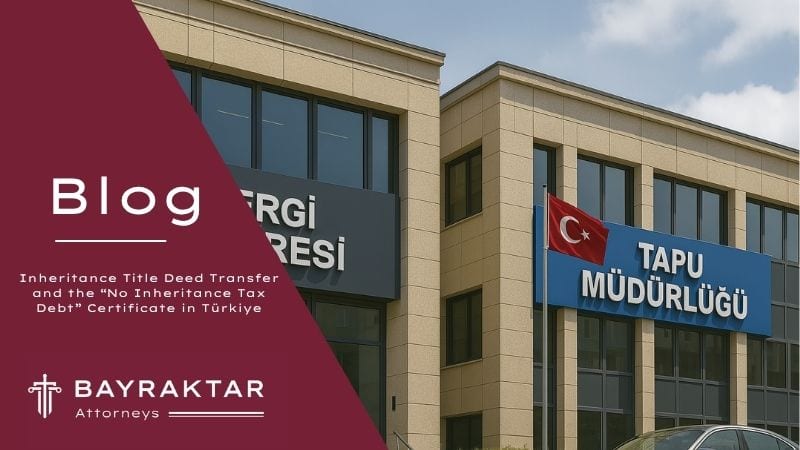
The General Directorate of Land Registry and Cadastre (Tapu ve Kadastro Müdürlüğü) is the main authority handling such property title transfers in Türkiye. However, before proceeding with any application, all related tax obligations must be fulfilled.
What Is the “No Inheritance Tax Debt” Certificate?
The “Veraset ve İntikal Vergisi Borcu Yoktur” certificate is an official document issued by the Turkish tax authority proving that all inheritance and transfer tax (veraset ve intikal vergisi) obligations have been met and that there are no outstanding tax debts regarding the inherited assets.
This certificate is mandatory to complete the title deed transfer process, claim bank accounts, or distribute inherited assets among heirs.
How to File the Inheritance and Transfer Tax Declaration
Before requesting the “no debt” certificate, heirs must file the Inheritance and Transfer Tax Declaration (Veraset ve İntikal Vergisi Beyannamesi).
Filing Deadlines
If the deceased passed away in Türkiye, the declaration must be filed within 4 months of death.
If the deceased passed away abroad, the deadline extends to 8 months.
Declarations can be submitted online via the Interactive Tax Office or in person at the relevant tax office.
Methods to Obtain the No Debt Certificate
There are three main methods to obtain the certificate:
a) Via the Interactive Tax Office (İnteraktif Vergi Dairesi)
Select and request the inheritance tax clearance document.
c) In Person at the Tax Office
Heirs visit the local tax office.
Submit the inheritance tax declaration.
Pay any due tax.
Request the clearance certificate in person.
Required Documents for Inheritance and Title Transfer
To proceed with inheritance and title deed registration, the following documents are typically required:
Inheritance Certificate (Veraset İlamı),
ID and tax numbers of heirs,
Property ownership documents (title deed),
Tax declaration forms,
Death certificate of the deceased,
Biometric photographs (50x60 mm),
Turkish notarized translations of foreign documents,
Signed statements from heirs confirming their familial relationship.
Important Note: If heirs are located abroad or a third party is handling the procedure, a notarized Power of Attorney (POA) will be needed. Obtaining the underlying certificate of inheritance is a key prerequisite before these documents can be assembled.
What Happens If the No Debt Certificate Is Not Obtained?
Without this document:
Title deed transfers cannot be completed.
Bank accounts of the deceased remain blocked.
Legal division of inherited assets cannot occur.
Utility changes, insurance claims, and municipal updates are halted.
This certificate is an indispensable part of the legal inheritance process in Türkiye.
How Long Does It Take to Obtain?
If all documents are in order and the inheritance tax has been paid, the certificate can typically be obtained within 2 to 5 working days. However, this may vary depending on:
The number of heirs,
The complexity of assets,
The workload of the local tax office.
Inheritance and Transfer Tax Rates in Türkiye (2026)
For 2026, the inheritance (veraset) and gratuitous transfer (ivazsız) tax rates in Türkiye are applied progressively based on the value of the inherited or transferred assets. For inheritances, the first 3,000,000 TL is taxed at 1%, the next 7,000,000 TL at 3%, the following 15,000,000 TL at 5%, the next 30,000,000 TL at 7%, and any amount exceeding 55,000,000 TL is taxed at 10%. For gratuitous transfers, such as gifts or donations, the same value brackets apply, but the tax rates are higher: 10%, 15%, 20%, 25%, and 30% respectively.
Note: These rates are applied progressively.
Who Is Exempt from Inheritance Tax?
Certain individuals and organizations are exempt from inheritance and transfer tax, including:
Local governments (municipalities, special provincial administrations),
Public institutions and professional chambers,
Heirs when the state becomes the inheritor,
Inheritances under specific court rulings or legal exceptions.
Handling Other Types of Inheritance
For inherited vehicles, heirs need to apply to the traffic registration authority with the appropriate documents. Inherited bank money requires obtaining a balance statement from the bank and ensuring the inheritance declaration reflects this amount. The procedure for withdrawing inherited money from the bank involves additional steps that heirs should prepare for in advance.
Legal Support for Inheritance Transfers
At Bayraktar Attorneys, we provide full legal services throughout the inheritance and property transfer process in Türkiye. Our assistance includes:
Drafting and submitting inheritance tax declarations,
Requesting the no-debt certificate from tax offices or online systems,
Coordinating with title deed offices for property transfer appointments,
Representing foreign or overseas heirs through Power of Attorney,
Solving disputes between heirs or with the administration.
Whether you are dealing with a broader matter of inheritance transfers in Turkey or simply need guidance from abroad, our multilingual team is here to guide you every step of the way.
Need Help? If you are an heir of a deceased person who owned assets in Türkiye, contact Bayraktar Attorneys today to ensure a smooth and lawful inheritance process.