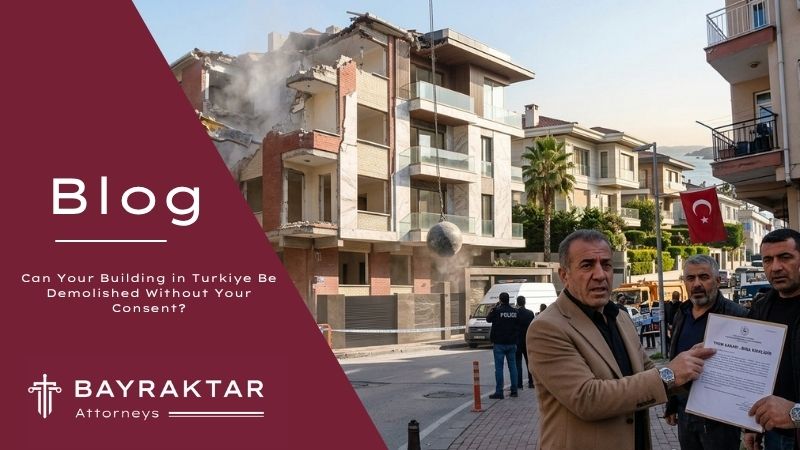
Quick answerYes: once a risky building (riskli yapı) determination under Law No. 6306 becomes final, demolition is mandatory regardless of owner consent, and any single owner can trigger the determination without informing the others. Owners have 15 days to object and 30 days to file an annulment action, though a court case does not itself halt demolition unless a stay of execution is granted. Since the 2023 amendments, owners have up to 90 days to demolish voluntarily, and reconstruction now requires only an absolute majority of land shares.
This guide explains what a risky building (riskli yapi) is under Turkish law, how the determination is made, what your rights are as a property owner or tenant, and the question that concerns owners most directly: whether your building can legally be demolished without your consent. The short answer to that question is yes, and understanding exactly how and when is essential for anyone who owns property in Turkey.
Turkey sits across some of the most seismically active fault systems in the world. The North Anatolian Fault runs directly beneath the Marmara region, and a significant proportion of the country's building stock was constructed before the modern seismic design codes and before the enforcement mechanisms now in place. The consequence is a legal framework that treats structural risk not as a private matter between owners, but as a question of public safety in which the state has broad and, in some circumstances, unilateral powers.
For foreign nationals who own property in Turkey, this framework is often unfamiliar and is rarely explained at the point of purchase. A building that appears entirely sound may be subject to a risky building determination initiated by a single co-owner. Once that determination becomes final, demolition is not optional, and it does not require the agreement of the owners. At Bayraktar Attorneys, we advise foreign property owners on every stage of this process, from responding to a determination through to the negotiation of the reconstruction arrangements that follow.
Quick Answer A risky building (riskli yapi) under Law No. 6306 is a structure that has completed its economic life or that carries a risk of collapse or severe damage, as determined by a licensed institution on the basis of scientific and technical data. Any single owner can request the determination; the consent of the others is not required. Once the determination becomes final, demolition is mandatory by operation of law and does not depend on owner agreement. Owners have 15 days from notification to object, and 30 days to bring an annulment action before the administrative court. Since November 2023, reconstruction decisions require only an absolute majority of land shares, not the two-thirds previously required, and the shares of owners who do not participate may be sold at auction.
1. What Is a Risky Building Under Turkish Law?
1.1. The Statutory Definition
The concept of the risky building is defined in Law No. 6306 on the Transformation of Areas Under Disaster Risk (Afet Riski Altindaki Alanlarin Donusturulmesi Hakkinda Kanun), which is the central legal instrument governing urban transformation in Turkey.
Law No. 6306, Article 2 A risky building is a structure located inside or outside a risky area that has completed its economic life, or that is determined, on the basis of scientific and technical data, to carry a risk of collapse or of sustaining severe damage.
Two distinct grounds are contained in this definition, and they operate independently of one another. The first is the completion of the building's economic life, which is a question of age, materials, and structural degradation. The second is the risk of collapse or severe damage, which is a technical assessment of the building's structural performance under seismic loading. A building may be determined risky on either basis.
1.2. Three Distinct Concepts: Risky Building, Risky Area, and Reserve Area
Law No. 6306 operates through three related but distinct concepts, and confusing them is a common source of error:
- Risky building (riskli yapi): an individual structure determined to be at risk. The determination attaches to that building alone, and the process described in this guide applies.
- Risky area (riskli alan): a defined geographic zone declared to be at risk, typically because of ground conditions or the concentration of vulnerable building stock. Declaration of a risky area brings all structures within its boundaries into the transformation framework regardless of their individual condition.
- Reserve building area (rezerv yapi alani): land designated for new development, used to accommodate residents relocated from risky areas and risky buildings.
The legal consequences differ substantially between these three categories, and the first question in any matter under Law No. 6306 is which of them applies to the property in question.
2. Who Can Initiate a Risky Building Determination?
This is the point at which most owners are surprised, and it is the single most important practical feature of the framework. A risky building determination may be requested by any owner of the building. The consent, agreement, or even the knowledge of the other owners is not required.
In a residential block with twenty apartments, a single owner may apply for a determination. If the licensed institution's technical report concludes that the building is risky, and that determination becomes final, the process that follows binds every owner in the building, including those who never wanted the assessment and who dispute its conclusions.
Determinations may also be initiated by the administration, by the Ministry, or by the Urban Transformation Presidency (Kentsel Donusum Baskanligi) on its own motion. In practice, however, a large proportion of determinations begin with the application of a single owner or a small group of owners, frequently in the context of a redevelopment opportunity where the land's value under current zoning permits a significantly larger new building.
Important Because a single owner can trigger the process, foreign owners who spend part of the year outside Turkey are particularly exposed. A determination can be applied for, the technical inspection carried out, the report finalised, and the notification period exhausted while the owner is abroad. Once the 15-day objection window has passed, the objection route is closed permanently. Property in Turkey requires an address at which notifications are genuinely monitored.
3. How the Determination Is Made
3.1. Licensed Institutions
Risky building determinations may only be carried out by institutions and organizations licensed for this purpose by the Ministry of Environment, Urbanisation and Climate Change. These include licensed engineering firms, universities, and certain public bodies. The engineers who conduct the assessment must be members in good standing of their professional chamber and must satisfy minimum professional experience requirements.
3.2. The Technical Assessment
The assessment involves physical inspection of the building, examination of the structural system, and testing to establish the actual characteristics of the materials used. In practice this typically includes core sampling of the concrete to determine compressive strength, scanning to establish the quantity and configuration of reinforcement, examination of the foundation and soil conditions where accessible, and structural analysis of the building's performance under the seismic loading applicable to its location.
The methodology is set out in the implementing regulation and its annexes, which prescribe the technical standards to be applied and the format in which the results must be recorded. The implementing regulation and the standard forms used in the determination process were most recently revised in February 2026, updating the technical report templates and strengthening the digital recording and notification infrastructure.
3.3. Review by the Directorate
The completed report is submitted to the relevant Provincial Directorate of Environment, Urbanisation and Climate Change, which reviews it for completeness and compliance with the applicable technical standards. Where deficiencies are identified, the report is returned to the licensed institution for correction within a defined period.
4. Notification and the Land Registry Annotation
4.1. How You Are Notified
The notification mechanism was substantially changed by Law No. 7471 in November 2023, and the current position differs from what many owners expect. Notification of a risky building determination is effected by:
- Posting the determination record on the building itself
- Notification to the owners through the e-Devlet portal
- Announcement at the relevant muhtarlik (neighbourhood administration) for a period of fifteen days
The determination is deemed to have been served on all holders of real and personal rights on the final day of the muhtarlik announcement. Risky buildings are additionally published on the Presidency's website for fifteen days.
Critical Point for Foreign Owners Notification is not effected by registered post to your home address, and it is not effected in your own language. It is effected by a notice posted on the building, an e-Devlet notification, and a fifteen-day announcement at the local muhtarlik. If you are not in Turkey, if you do not monitor your e-Devlet account, and if no one is checking the building, the entire notification period can pass without your becoming aware of it. The objection deadline runs regardless.
4.2. The Annotation on the Title Deed
Once the determination is made, an annotation recording the risky building status is entered on the land registry record of every independent unit in the building. This annotation has immediate practical consequences: it is visible to any prospective purchaser or lender conducting a title search, it affects the marketability and financing of the property, and it signals the commencement of a process that will, absent a successful challenge, end in the demolition of the building.
5. Your Right to Object: The 15-Day Window
5.1. Who May Object and Within What Period
Owners and their legal representatives may object to a risky building determination within fifteen days of notification. This is a forfeiture period (hak dusurucu sure): an objection filed even one day late will be rejected without examination of its merits, and the administrative objection route is then closed permanently.
The right to object belongs to the owners and, where applicable, their legal representatives and heirs. Tenants and holders of limited real rights do not have standing to object to the determination itself, although they are affected by its consequences and have standing in relation to the eviction and demolition measures that follow.
5.2. Where and How the Objection Is Filed
The objection is filed in writing with the Provincial Directorate of Environment, Urbanisation and Climate Change in the province where the building is located, or with the authorised municipal unit where authority has been delegated.
A critical practical point: the full technical report is not automatically served on the owners. Only the outcome is notified. An owner intending to object should therefore request a copy of the report from the relevant authority immediately upon notification, because an objection that does not engage with the technical content of the report is very unlikely to succeed.
5.3. What Makes an Objection Effective
A general statement that the owner does not wish the building to be demolished is not an objection in any meaningful sense and will be rejected by the technical committee. An effective objection must identify specific technical or procedural defects. The grounds most commonly relied upon are:
- The testing methodology did not comply with the standards prescribed in the implementing regulation
- The number or location of core samples was inadequate to support the conclusions drawn
- The structural analysis contained calculation errors or applied incorrect parameters
- The building's actual structural system was misidentified in the report
- The soil and foundation assessment was inadequate or was not carried out
- The licensed institution or the engineers involved did not hold the required qualifications
- Procedural defects in the conduct of the assessment or the notification
From Our Practice In our experience, the objections that succeed are those supported by an independent technical opinion obtained from a qualified structural engineer. Obtaining such an opinion within the fifteen-day window is demanding but achievable if the process is started immediately upon notification. An objection consisting only of legal argument, without technical substance addressing the report's findings, is at a significant disadvantage before a committee composed principally of engineers.
5.4. The Technical Committee
Objections are examined by a technical committee established for this purpose. The committee is composed of seven members: four academic staff selected by universities in the relevant technical disciplines, and three officials from the Ministry. At least five members must participate in the decision, and decisions are taken by majority vote.
The committee is not bound by the grounds raised in the objection. It examines the determination in all its aspects, which means that a well-founded objection on one ground may lead the committee to identify defects the objector had not raised. Where the committee identifies deficiencies in the report, it may return the report to the licensed institution for correction within thirty days.
Where the committee concludes that the building is not risky, the determination is cancelled and the annotation is removed from the land registry. Where the objection is rejected, the determination becomes final and the demolition process begins.
6. Court Proceedings: The Annulment Action
6.1. Time Limit and Competent Court
A risky building determination is an administrative act and may be challenged by an annulment action before the administrative court. The time limit is thirty days, which is shorter than the sixty-day period that applies to administrative acts generally, because Law No. 6306 contains a specific provision to this effect.
The thirty-day period runs from notification of the determination where no objection was filed, or from notification of the technical committee's rejection where an objection was filed and rejected. The competent court is the administrative court in the jurisdiction where the building is located.
6.2. The Critical Importance of a Stay of Execution
Filing an annulment action does not, by itself, suspend the demolition process. Administrative acts in Turkish law remain enforceable while under challenge unless the court orders otherwise. An owner who files an annulment action without applying for a stay of execution (yurutmenin durdurulmasi) may find that the building is demolished while the case is still pending, at which point the annulment action becomes largely academic.
The application for a stay must therefore be made together with the annulment action, and it must be supported by evidence establishing both that the act is manifestly unlawful and that its execution would cause damage that is difficult or impossible to remedy. The demolition of a building is, by its nature, irreversible, which supports the second limb of the test, but the first limb requires substantive evidence of unlawfulness.
Important Stay of execution applications in urban transformation cases are not routinely granted. The courts weigh the owner's property interest against the public safety objective of the legislation, and the balance frequently favours the latter where the technical report is not shown to be seriously defective. This is another reason why the independent technical evidence supporting the challenge is decisive: without it, the application is unlikely to succeed.
7. Can Your Building Be Demolished Without Your Consent?
This is the question that brings most owners to us, and the answer requires no qualification: yes.
Once a risky building determination becomes final, whether because no objection was filed, because the objection was rejected, or because a court challenge failed, the demolition of the building is a mandatory requirement of the law. It is not a decision that the owners take. No majority is required, no agreement among the owners is required, and the objection of individual owners has no legal effect on the obligation.
7.1. The Demolition Timetable
Following the amendments introduced by Law No. 7471 in November 2023, the demolition timetable operates as follows:
- The owners are given a period of not more than ninety days to evacuate and demolish the building themselves. This replaced the previous system of an initial sixty-day period followed by a thirty-day extension.
- The demolition permit is issued within six working days of application by any one owner or their representative, on submission of evidence that the building has been evacuated and that electricity, water, and gas services have been disconnected, and on the designation of a technically responsible person for the demolition. The consent of the other owners is not required for the demolition permit.
- Where the building has not been demolished within the period given, the administration proceeds to demolish it.
7.2. Enforcement Measures
Where owners or occupants do not evacuate within the period given, the law provides the administration with escalating enforcement tools:
- Electricity, water, and natural gas services to the building are disconnected on the request of the administration, and the utility providers are obliged to comply.
- The evacuation of people and belongings, and the demolition itself, are carried out by the administration with the support of law enforcement where necessary.
- Following the 2023 amendments, where a building is not evacuated within the period given, the Presidency may request written authorisation from the civil administration to open or have opened closed doors and areas using sufficient police force, in order to carry out the evacuation and demolition.
- The costs of evacuation and demolition are recovered from the owners in proportion to their shares.
7.3. Article 6/A: Where No Consent Is Required at Any Stage
A separate and more far-reaching provision applies where buildings are at imminent risk of collapse, or where buildings have collapsed or sustained severe damage as a result of ground movement, landslide, flooding, rockfall, fire, explosion, or similar causes. In these areas, Article 6/A of Law No. 6306 permits transformation applications to be carried out by the Presidency on its own motion without the consent of the owners or other interested parties at any stage.
Under this provision, all land registry and cadastral transactions, all permits and licences relating to demolition and construction, and all procedures before other administrative bodies are carried out on the Presidency's request without the consent of owners or interested parties. Where an emergency evacuation is required, an accelerated procedure applies with a two-day objection period and a three-day period for the technical committee to decide.
8. The Reconstruction Decision: What Changed in 2023
Demolition and reconstruction are legally separate questions. Demolition is mandatory and requires no decision by the owners. What is to be built in place of the demolished building, and on what terms, is a decision the owners must take collectively, and this is where the most significant recent legal change has occurred.
8.1. From Two-Thirds to Absolute Majority
When Law No. 6306 was first enacted, decisions on reconstruction, including the selection of a contractor, the terms of a construction agreement, and the allocation of the new units, required the agreement of owners representing at least two-thirds of the land shares. In practice, this threshold proved difficult to reach in many buildings, and a small minority of owners could hold a project in suspension indefinitely.
Law No. 7471, published in the Official Gazette on 9 November 2023, replaced the two-thirds requirement with an absolute majority of land shares. The decision-making threshold is now more than half of the total land share, frequently referred to in practice as the P+1 rule.
| Question |
Position Before November 2023 |
Current Position |
| Threshold for reconstruction decisions |
Two-thirds of land shares |
Absolute majority of land shares (more than 50 percent) |
| Basis of calculation |
Land share, not number of owners |
Land share, not number of owners (unchanged) |
| Demolition period |
60 days plus 30-day extension |
Single period of not more than 90 days |
| Notification method |
Service on owners |
Posting on building, e-Devlet, 15-day muhtarlik announcement |
| Consequence for non-participating owners |
Share sale procedure |
Share sale by auction, first to participating co-owners, then to third parties |
8.2. How the Majority Is Calculated
The calculation is based on land share (arsa payi) as recorded in the land registry, not on the number of owners or the number of independent units. This distinction is decisive in practice. In a building where ground floor commercial units carry disproportionately large land shares, a small number of owners may control the absolute majority. Conversely, an owner with a large land share may find themselves outvoted by a coalition of owners with smaller shares.
The first step for any owner concerned about a transformation decision in their building is therefore to obtain the current land registry records and calculate the actual distribution of land shares. Assumptions based on the number of apartments are frequently wrong.
9. What Happens to Owners Who Do Not Participate
Where a decision is taken by owners representing the absolute majority of land shares, the decision is notified to the owners who did not participate. Those owners are given a period, in practice fifteen days, in which to join the agreement.
Where an owner does not join within that period, their land share may be sold. The procedure operates as follows:
- A market value (rayic bedel) is determined for the non-participating owner's share, by a valuation firm licensed by the Capital Markets Board or by a commission established within the provincial directorate.
- The share is first offered by auction to the co-owners who participated in the agreement. Where more than one participating owner wishes to acquire it, the share is auctioned between them.
- Where no participating co-owner acquires the share, it is offered at auction to third parties who undertake to comply with the agreement.
- The sale may not be concluded below the determined market value. Where the auction does not produce a bid at or above that value, the process is repeated until a sale is achieved.
- On payment of the price, the share is transferred in the land registry to the purchaser, who takes the place of the previous owner and is bound by the transformation decision.
From Our Practice The determination of the market value is the point at which non-participating owners are most frequently prejudiced, and it is where legal intervention is most effective. Valuations that do not adequately reflect the development value of the land under current zoning, or that are based on the condition of the existing building rather than the value of the share in the parcel, are open to challenge. Owners who disagree with the valuation should obtain an independent valuation and challenge the determination rather than allowing the sale to proceed unchallenged.
10. Financial Support Available to Owners and Tenants
The transformation framework provides financial support to those displaced by the process. The categories are as follows:
- Rent assistance (kira yardimi): monthly payments to owners who have evacuated a risky building, for a defined period. The amounts are set annually by the Ministry and vary by province, with higher amounts in the major metropolitan areas.
- Relocation assistance (tasinma yardimi): a single payment available to tenants and, in certain circumstances, to holders of limited real rights who were resident in the building.
- Interest-subsidised credit: support for the financing of reconstruction, available as an alternative to rent assistance. It is generally not possible to benefit from both.
- Fee and tax exemptions: transactions carried out under Law No. 6306 benefit from exemptions from certain land registry fees, stamp duty, and other charges.
Applications for rent assistance must be made within one year of the evacuation date. The application requires the evacuation record or evidence of utility disconnection, the title deed for owners or the lease for tenants, and evidence of residence at the address. The amounts are revised annually and should be confirmed with the relevant provincial directorate at the time of application rather than relied upon from secondary sources.
11. Specific Considerations for Foreign Property Owners
Foreign owners face a set of practical difficulties in this framework that Turkish owners generally do not.
The first is notification. The current notification mechanism, based on posting a notice on the building, an e-Devlet notification, and a muhtarlik announcement, assumes a level of local presence and engagement that many foreign owners do not have. An owner who is abroad and does not monitor their e-Devlet account may lose the objection right entirely without ever having been aware that a determination was made.
The second is language. The technical report, the notification, the objection procedure, and the court proceedings are conducted entirely in Turkish. The fifteen-day objection window does not allow time for translation, comprehension, the instruction of a technical expert, and the preparation of a substantive objection unless the owner has legal representation already in place.
The third is the collective decision-making process. Reconstruction decisions are taken in meetings and through written agreements among the owners. A foreign owner who is not present, who does not speak Turkish, and who has no representative in Turkey is effectively excluded from the negotiation of terms that will determine what they receive in the new building.
Practical Recommendation We recommend that foreign owners of property in Turkey put in place a limited power of attorney covering urban transformation matters, and designate a Turkish address at which notifications are actively monitored. The cost of doing so in advance is negligible compared to the cost of losing the objection right or being excluded from the reconstruction negotiations. We routinely act under such powers of attorney for clients who are not resident in Turkey.
12. The Timetable at a Glance
| Stage |
Period |
Consequence of Inaction |
| Notification of determination |
15-day muhtarlik announcement; deemed served on final day |
Time begins to run whether or not you are aware |
| Administrative objection |
15 days from notification |
Objection route closed permanently |
| Technical committee decision |
Examined by 7-member committee, minimum 5 participating |
Determination becomes final on rejection |
| Annulment action |
30 days from notification or from rejection of objection |
Court challenge barred |
| Stay of execution application |
Filed together with the annulment action |
Demolition may proceed while the case is pending |
| Demolition by owners |
Not more than 90 days from finalisation |
Utilities disconnected; administration demolishes; costs recovered from owners |
| Joining the reconstruction agreement |
15 days from notification of the majority decision |
Land share may be sold at auction |
| Rent assistance application |
1 year from evacuation |
Entitlement lost |
13. Frequently Asked Questions
13.1. Can my building be demolished if I do not agree?
Yes. Once a risky building determination becomes final, demolition is a mandatory requirement of Law No. 6306. It does not require the agreement of the owners, and the objection of individual owners does not affect the obligation. The only way to prevent demolition is to overturn the determination itself, through the administrative objection within fifteen days or an annulment action before the administrative court within thirty days.
13.2. Can one owner in my building start this process without telling the rest of us?
Yes. Any single owner may apply for a risky building determination, and the consent or knowledge of the other owners is not required. The other owners become aware of it through the notification process after the determination has been made. This is one of the most significant practical features of the framework and the reason why monitoring notifications is essential.
13.3. I was abroad and missed the 15-day objection deadline. What can I do?
The fifteen-day objection period is a forfeiture period and cannot be extended. However, the thirty-day period for bringing an annulment action before the administrative court is separate and may still be available, since it runs from notification of the determination where no objection was filed. Whether that route remains open depends on the dates involved. If you have missed the objection deadline, obtain legal advice immediately, because the court route has its own deadline and it is also short.
13.4. Does filing a court case stop the demolition?
No, not automatically. Administrative acts remain enforceable while under challenge unless the court orders a stay of execution. An owner who files an annulment action without applying for a stay may find the building demolished while the case is pending. The stay application must be made together with the annulment action and must be supported by evidence of manifest unlawfulness.
13.5. What is the current majority required to decide on reconstruction?
An absolute majority of land shares, meaning more than fifty percent. This was reduced from the previous two-thirds requirement by Law No. 7471 in November 2023. The calculation is based on land share as recorded in the land registry, not on the number of owners or apartments, which can produce results that are counter-intuitive in buildings with unequal land share distribution.
13.6. What happens if I refuse to join the reconstruction agreement?
Your land share may be sold. Following notification of the majority decision, owners who do not join within the period given may have their share valued and sold at auction, first to the participating co-owners and then, if none acquires it, to third parties who undertake to comply with the agreement. The sale may not be concluded below the determined market value. The purchaser takes your place as a co-owner and is bound by the transformation decision.
13.7. Can I challenge the valuation of my share?
Yes. The market value determination is an administrative act and may be challenged. In our experience this is the most productive point of intervention for owners who have been outvoted, since valuations that do not properly reflect the development value of the land under current zoning are open to substantive challenge. An independent valuation supporting the challenge significantly strengthens the position.
13.8. As a tenant, what are my rights when the building is determined risky?
Tenants do not have standing to object to the determination itself, which is a right reserved to owners and their legal representatives. However, tenants must evacuate within the period given, and relocation assistance is available to tenants who were resident in the building. Tenants should also review their lease, since the demolition of the leased property affects the lease relationship and may give rise to claims depending on the circumstances and the terms of the agreement.
13.9. Will the electricity and water really be cut off?
Yes, where the building has not been evacuated and demolished within the period given. Law No. 6306 provides for electricity, water, and natural gas services to be disconnected on the request of the administration, and the utility providers are obliged to comply. Following the 2023 amendments, the administration may also obtain written authorisation to open closed doors and areas using police force in order to complete the evacuation.
13.10. What should a foreign owner do to protect themselves?
Put a limited power of attorney in place covering urban transformation matters, designate a Turkish address at which notifications are actively monitored, and ensure your e-Devlet account is accessible and checked. The fifteen-day objection window does not allow time to arrange representation from abroad after a determination has been notified. Owners who have these arrangements in place before a determination arises are in a substantially better position than those who begin arranging representation after notification.
13.11. Does a risky building determination mean my building is about to collapse?
Not necessarily. The statutory definition covers both buildings at risk of collapse or severe damage and buildings that have completed their economic life. A determination may be made on either basis. The technical content of the report is what matters, and this is precisely why obtaining a copy of the report and, where appropriate, an independent technical opinion, is the first step for any owner who wishes to challenge the determination.
13.12. Can I sell my apartment after a risky building annotation is placed on the title?
A sale is not legally prohibited by the annotation, but the annotation is visible on the land registry record and will be seen by any purchaser conducting a title search. In practice this substantially affects both the marketability and the price of the property, and financing is generally unavailable. Any purchaser acquires the property subject to the transformation process and its consequences.
Conclusion
Turkey's urban transformation framework reflects a deliberate legislative judgment: that in a country where a substantial proportion of the building stock is seismically vulnerable, the collective interest in structural safety takes precedence over the individual owner's preference to leave a building standing. The 2023 amendments reinforced that judgment, lowering the reconstruction threshold, shortening the demolition timetable, and strengthening the enforcement mechanisms available to the administration.
For owners, the practical consequence is that the window in which meaningful legal action is possible is narrow. Fifteen days to object, thirty days to bring a court challenge, and fifteen days to join a reconstruction agreement. Each of these periods is a forfeiture period, and each begins running on a notification that may never physically reach you.
The owners who protect their position most effectively are not those who react quickly after a determination is made, but those who have their monitoring and representation arrangements in place before one arises. For foreign owners in particular, whose exposure to the notification mechanism is structurally greater, this preparation is not a precaution. It is the difference between having legal options and having none.
Speak with Bayraktar Attorneys
At Bayraktar Attorneys, we act exclusively for foreign nationals in Turkey. We advise property owners at every stage of the urban transformation process: challenging risky building determinations, filing objections and annulment actions with stay applications, representing owners in reconstruction negotiations, challenging share valuations, and acting under power of attorney for clients who are not resident in Turkey. If your building has been determined risky, or if you own property in Turkey and want to put protective arrangements in place before a determination arises, contact us for a confidential consultation.
This article is prepared for general information purposes and reflects the legal position as at the date of publication. Law No. 6306 and its implementing regulation have been amended frequently, most recently in February 2026, and the applicable rules, financial support amounts, and procedural requirements are subject to change. This article does not constitute legal advice and should not be relied upon without examination of the specific facts of your case.