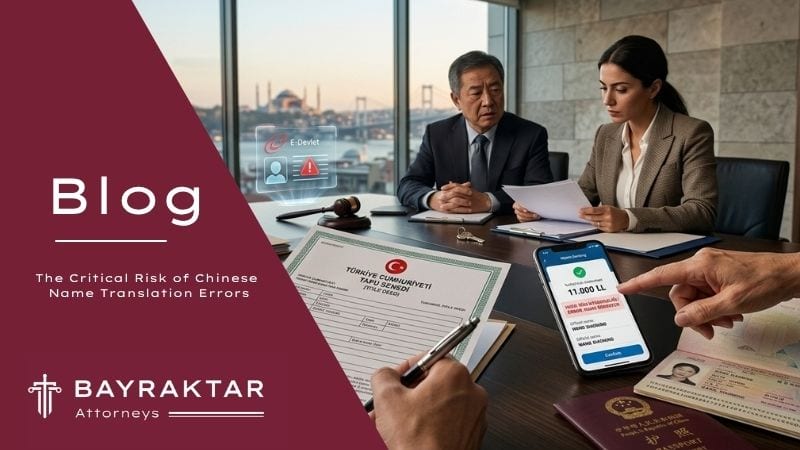
Quick answerIn Turkey, any official transaction, including real estate purchases, company registration, or a Turkish Citizenship by Investment application, must use the exact Latin-character spelling on the main data page of the applicant's PRC passport, not an English alias or an inconsistent Pinyin transliteration. Because Turkish systems cross-check identity records by exact match, even a one-letter mismatch between the passport and a translated document, bank transfer, or contract can block registration or void a signature.
This guide explains how English aliases, Pinyin spelling shifts, and sworn translation errors stall Turkish Citizenship by Investment files, invalidate real estate titles, and block company registrations, and it sets out how to legally secure your application from the first document onward.
For citizens of the People's Republic of China (PRC) looking to invest globally, the Turkish Citizenship by Investment (CBI) programme offers an exceptional path to citizenship through real estate acquisition or capital contribution. Turkey combines a strategic location bridging Europe and Asia, a comparatively accessible investment threshold, and a passport with broad visa-free and visa-on-arrival access, which together make it one of the most attractive citizenship programmes available to Chinese investors. However, an administrative hurdle frequently stalls or completely rejects these high-stakes files: name discrepancies and transliteration errors in official paperwork.
In daily life, many Chinese nationals adopt Western or English names, such as John, Mary, or David, for convenience in international business and travel. Furthermore, converting Chinese characters into the Latin alphabet through the Pinyin system often leads to structural modifications or outright clerk errors by sworn translators. In Turkey's highly centralized and digitalized bureaucratic framework, which includes E-Devlet, the Land Registries, and the Population Directorates, even a one-letter mismatch can lead to the total invalidation of real estate purchases, corporate registrations, or citizenship dossiers. Understanding why these errors arise, and how to prevent them before a file ever reaches a government desk, is one of the most valuable forms of preparation a Chinese investor can undertake.
Quick Answer In Turkey, any official legal transaction, whether purchasing real estate, establishing a company, or applying for Turkish Citizenship by Investment, must rely strictly on the Latin character spelling found on the main data page of the PRC passport. Using a daily English alias, signing documents with an unofficial English name, or submitting translations with Pinyin character errors, for example misspelling Zhang, will lead to immediate bureaucratic rejection and the potential loss of legal rights. The passport is the single source of truth, and every other document in the file must match it exactly.
1. Why Do Chinese Name Discrepancies Occur?
Document mismatches are far more common than most applicants anticipate, particularly when navigating transitions between non-Latin scripts, such as Mandarin characters, and the Latin alphabet. Because the Turkish system was designed around Latin-script identity data, any name that originates in another script must pass through a conversion process, and each conversion is an opportunity for error. These discrepancies typically stem from three main bottlenecks.
1.1. Transliteration Shifts and Pinyin Nuances
When converting Mandarin names to Latin characters, the official Pinyin system must be meticulously followed. Different administrative authorities or overseas translators sometimes employ varying phonetic rules, and older romanization systems such as Wade-Giles occasionally surface in historical documents, producing spellings that differ from modern Pinyin. For instance, certain nuances in surnames such as Zhang, Xiao, or Wang can be altered or misspelled during translation, causing the name on a birth or marriage certificate to deviate from the passport. Tone marks, which appear over vowels in academic Pinyin but not on the passport data page, are another frequent source of inconsistency, as a translator who reproduces or omits them inconsistently can create a string that no longer matches the passport character for character.
1.2. The Use of English Aliases and Nicknames
Many Chinese business professionals use Western first names in international commerce, on business cards, in email signatures, and in day to day correspondence. Problems arise when an investor mistakenly uses an alias on unofficial preliminary contracts, powers of attorney, or wire transfer descriptions. Turkey does not legally recognize these adopted English names unless they are formally registered as part of an official name change in the home country and reflected on the passport itself. An English name that feels entirely natural in a business setting has no legal standing in a Turkish government database, and its appearance on a single document can be enough to break the chain of identity across the file.
1.3. Structural Name Inversions
In Chinese naming traditions, the family name, or surname, precedes the given name. Western and Turkish administrative systems, however, place the given name first. This structural inversion regularly leads to clerical mistakes where names are swapped in official Turkish entry forms or corporate articles of association. For example, an investor named Wang Xiaoming, whose surname is Wang, may be incorrectly recorded in a Turkish form as though Xiaoming were the surname and Wang the given name. Once this inversion enters one database, it can propagate to others, and untangling it later requires formal correction across every affected record.
2. Key Legal Risks and Consequences in Turkish Bureaucracy
The Turkish government cross-checks identity parameters across multiple state databases, including Nufus (the population registry), Tapu (the land registry), and the immigration systems. Because these systems are interconnected and rely on exact matching rather than approximate matching, a failure to maintain uniform naming profiles across all files carries significant and compounding risks.
- System disconnection (E-Devlet and Nufus): if the name written on a translation or application form does not match the exact passport string, Turkish population databases will fail to match the data, completely blocking the issuance of residence permits or citizenship files. The system does not interpret intent or recognize that two spellings refer to the same person. It simply fails to find a match, and the file cannot advance.
- Invalidation of signatures: signing an official Turkish document, a real estate sales contract, or a corporate declaration using an English alias, for example signing as John Wang instead of Wang Xiaoming, renders the signature and the document legally void. A void signature can unravel an entire transaction, and in some cases the defect is only discovered at a later, more costly stage.
- Transaction cancellations: the Land Registry (Tapu) will reject property transfers if the buyer's name on the bank transfer slip differs from the passport data page. Similarly, the Trade Registry will reject or cancel company formations or share transfers due to name inconsistencies. Since the CBI real estate route depends on a clean, registered title in the applicant's exact legal name, a mismatch here can directly jeopardize the citizenship application that the property was intended to support.
Why This Matters For a Chinese CBI applicant, these risks are not independent. A single alias on a wire transfer can cause the Land Registry to reject the transfer, which prevents the title from being registered in the correct name, which in turn removes the evidentiary basis for the citizenship application. One small inconsistency at the payment stage can therefore cascade through the entire file. Consistency is not a formality; it is the structural integrity of the whole application.
3. Critical Documents and the Turkish CBI Target
For Chinese investors seeking Turkish citizenship, the cross-examination of vital records is exceptionally strict. The Turkish CBI evaluation units review every document with a zero-tolerance policy for spelling deviations, because the citizenship file must stand up to scrutiny not only at the point of application but for the entire life of the resulting citizenship. The table below sets out the core documents and the specific verification points that most often determine whether a file proceeds smoothly or stalls.
| Crucial CBI Document |
Critical Information to Verify |
Risk of Mismatch |
| PRC Passport |
The absolute source of truth. All Latin spellings must be mapped from here. |
Any variation in other documents will stall the file. |
| Birth Certificate |
Parent names, applicant's name, and place of birth. |
Pinyin spelling errors can break the proof of lineage. |
| Marriage Certificate |
Spousal names and marital status tracking. |
Divergent transliterations can block family inclusion in the CBI file. |
| Family Registry (Nufus Kayit Ornegi equivalent) |
Detailed lineage, maternal and paternal names, and demographic annotations. |
Vital records that fail to match Turkish identity databases perfectly. |
When compiling family records, which function exactly like the Turkish Vukuatli Nufus Kayit Ornegi (a detailed family registration showing marriages, births, and parental links), every single character must align flawlessly across the generation tree. This is particularly important where the CBI file includes dependents, because the eligibility of a spouse or a child is proven through exactly these lineage documents. A transliteration error that appears only in a parent's name on a child's birth certificate can still be enough to cast doubt on the family relationship the file is trying to establish.
4. How to Prevent and Resolve Transliteration Errors
To ensure a smooth legal process in Turkey, Chinese investors and their advisors should follow a strict compliance sequence before submitting any files to Turkish ministries. The aim is to catch every discrepancy at the preparation stage, where correction is cheap and fast, rather than at the government submission stage, where correction is slow, costly, and sometimes damaging to the timeline of the whole investment.
4.1. Step 1: Establish the Passport as the Master Reference
Before any translation occurs, establish the current, valid PRC passport as the absolute master reference for spelling. Every translation, bank account opening form, and property deed must duplicate this Latin string precisely, regardless of colloquial naming preferences. In practice, this means circulating a single, agreed spelling of the applicant's name to every party involved, the translator, the bank, the notary, the real estate agent, and the law firm, so that no one improvises an alternative version. Treating the passport data page as the only permissible spelling from the very first document eliminates the majority of mismatch problems before they can arise.
4.2. Step 2: Use Qualified, Turkey-Recognized Sworn Translators
Do not rely on generic translation bureaus located outside Turkey for official submissions. Documents must be translated by a certified Turkish sworn translator and, depending on where they are issued, must bear an Apostille or be fully legalized by the Turkish Consulate or Embassy. A Turkey-recognized sworn translator understands how Turkish authorities expect names to be rendered and how they will be matched against the passport, which a general overseas bureau may not. The additional cost of using a qualified sworn translator is negligible compared with the cost of a rejected citizenship file.
4.3. Step 3: Implement Pre-Submission Audits
Examine every line of the translated texts. Pay specific attention to numbers, birth locations, and Pinyin consonant blends such as Zh, X, Q, and C, which are the combinations most frequently mishandled. If a typo is discovered, the translation must be corrected and re-certified before it reaches government desks. A disciplined pre-submission audit, ideally performed by someone other than the person who prepared the documents, is the final safeguard that catches the errors everyone else has read past.
Illustrative Example Consider an investor whose passport reads Wang Xiaoming. Their birth certificate translation renders the surname as Wong, their bank transfer slip describes the sender as their English alias David Wang, and their preliminary sales contract is signed David Wang. Each of these looks harmless in isolation. Together, they present the Turkish authorities with three different identities for one person: Wang Xiaoming, Wong Xiaoming, and David Wang. The Land Registry cannot match the payment to the buyer, the population database cannot match the birth certificate to the passport, and the file stops. Correcting all three back to the single passport spelling before submission would have prevented the entire problem.
5. How We Support Chinese Investors in Turkey
Navigating Turkish bureaucracy requires both specialized legal expertise and cultural awareness of how Chinese naming conventions interact with a Latin-script system. Our firm specializes in assisting Chinese investors and families of Chinese descent in successfully securing their Turkish Citizenship by Investment and corporate portfolios.
We eliminate name-mismatch risks at the earliest phases of file preparation. From auditing your home-country vital statistics to ensuring that your Turkish bank accounts, property deeds, and family certificates are harmonized perfectly with your passport, our legal team provides secure representation across every document in the file. We act as your liaison with the Land Registry, the Trade Registry, and the citizenship offices, handling all technical verifications so that your file moves forward without bureaucratic delays. Where a discrepancy already exists, we manage the corrective process, arranging re-translation, re-certification, and where necessary formal amendment of signed documents, so that the identity chain across your file is restored before it becomes a reason for rejection.
6. Frequently Asked Questions About Chinese Name Discrepancies in Turkish Legal Procedures
6.1. Can I use my registered English name on my Turkish title deed (Tapu)?
Only if your English name is officially recorded as your legal name on the data page of your PRC passport. If it is merely an unofficial alias or nickname, it cannot be used on any official document in Turkey. The title deed must state your official Pinyin name exactly as written in your passport. Using an alias on the deed, even one you use every day in business, will create a mismatch that the Land Registry cannot reconcile.
6.2. My birth certificate translation has a one-letter Pinyin error compared to my passport. Will this affect my CBI application?
Yes. The Turkish citizenship evaluation units cross-check all identity parameters across your dossier. A single-letter discrepancy can freeze your application, and the authorities may return the file for correction. You should have the document re-translated and corrected by a certified Turkish sworn translator before submission. It is far faster to correct one letter at the preparation stage than to have an entire citizenship file returned for that same letter.
6.3. What happens if I signed a contract using my English alias name?
Contracts signed with an unofficial English alias are highly vulnerable to being declared legally invalid. Under Turkish law, signatures must match your legal identity as it appears on your passport. If this has occurred, you should immediately execute a corrective amendment or a new agreement using your official passport name, under professional legal guidance, so that the document is placed on a sound legal footing before it is relied upon in any transaction.
6.4. Why is a detailed family certificate (Nufus Kayit Ornegi equivalent) required for Chinese CBI applicants?
Turkey requires comprehensive proof of lineage to process dependent family members, meaning a spouse and children under 18, within a single investment file. This document tracks vital life events such as births, marriages, and parental connections. Ensuring that all names within this family ledger are translated without Pinyin errors is critical to confirming your family's eligibility for citizenship, because the family relationship itself is proven through the consistency of the names across these records.
6.5. Which name should appear on the bank transfer for my property purchase?
The name on the bank transfer must match your PRC passport data page exactly, character for character. The Land Registry compares the sender name on the payment record against the passport when registering the title, and any divergence, including the use of an English alias in the transfer description, can cause the transfer to be rejected. Since the CBI real estate route depends on the payment being cleanly attributable to you, this is one of the highest-risk points in the entire process and should be confirmed before any funds are sent.
6.6. Can I fix a name discrepancy after my documents are already in the Turkish system?
Yes, but it is more difficult and time-consuming than preventing it. Correcting a discrepancy that has already entered the Nufus, Tapu, or immigration databases typically requires re-translated and re-certified documents, and in some cases formal applications to amend the affected records. Because the databases are interconnected, a correction may need to be reflected in more than one system. This is why early, preventive verification is strongly preferable to later correction, and why we audit the full document set at the outset.
Conclusion
For Chinese investors, the Turkish Citizenship by Investment programme is an accessible and attractive route to a powerful second passport, but its success depends on a detail that is easy to underestimate: the perfect consistency of your name across every document. In a centralized, digitalized system built on exact matching, the passport data page is the single source of truth, and any deviation, whether a Pinyin slip, an English alias, or a name inversion, can stall a file or invalidate a transaction.
The good news is that these problems are almost entirely preventable. By fixing the passport spelling as the master reference, using Turkey-recognized sworn translators, and auditing every document before submission, a Chinese investor can remove the most common cause of CBI delays before it ever arises. Where a discrepancy already exists, it can be corrected, but the earlier it is caught, the cheaper and faster the fix.
Need Expert Legal Counsel for Your Investment in Turkey?
Preventing technical transliteration errors requires early detection and strict legal oversight. If you are a Chinese investor planning to buy real estate, establish a business, or apply for the Turkish Citizenship by Investment programme, our specialized legal team is here to secure your path. Contact Bayraktar Attorneys today to schedule a comprehensive consultation with a skilled Istanbul immigration and real estate lawyer, and ensure your documentation is flawless from day one.