Quick answerTurkey's Law No. 6306 governs the demolition and reconstruction of structurally unsafe buildings, and 2026 amendments changed how decisions are made. A single co-owner can now trigger a risk assessment without others' consent, and once a building is declared risky, owners can object within 15 days administratively or file an annulment action within 30 days. Reconstruction decisions on contractor selection can now be adopted by a simple majority (50%+1) of meeting attendees rather than the previous two-thirds threshold.
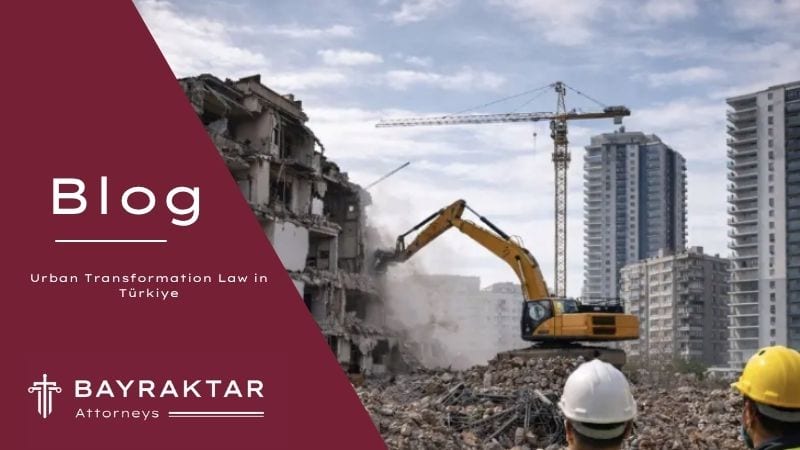
Urban transformation in Türkiye has evolved into one of the most critical legal and practical frameworks shaping real estate, construction, and property rights. Particularly in earthquake-prone regions such as Istanbul, the transformation of structurally unsafe buildings is not only a regulatory requirement but also a necessity for public safety.
Governed primarily by Law No. 6306 on the Transformation of Areas Under Disaster Risk, the process has undergone significant reforms over the years. The most recent amendments introduced in 2026 have fundamentally changed how decisions are made, how dissenting owners are treated, and how administrative procedures are conducted.
This guide provides a clear and practical overview of the legal structure of urban transformation, helping property owners, investors, and stakeholders understand their rights, obligations, and potential risks.
Legal Basis of Urban Transformation in Türkiye
The legal foundation of urban transformation lies in Law No. 6306 and its Implementing Regulation. The purpose of this legislation is to eliminate buildings that pose a risk to life and property due to structural deficiencies, outdated construction techniques, or seismic vulnerability.
In practice, the law enables authorities and property owners to initiate the demolition and reconstruction of risky buildings through a structured administrative process. Unlike traditional construction law procedures, urban transformation law introduces expedited mechanisms to prevent delays caused by ownership disputes.
The 2026 regulatory updates further strengthened this framework by simplifying procedures and reducing bureaucratic ambiguity, particularly in areas such as notification methods, registry annotations, and majority decision-making.
Why Urban Transformation Has Become a Priority
Türkiye's geographical position along major fault lines makes earthquake resilience a national priority. Past seismic events have demonstrated the devastating consequences of inadequate construction standards and delayed urban renewal.
Urban transformation aims to address these risks by:
Replacing outdated and unsafe structures
Improving compliance with modern building codes
Enhancing urban infrastructure and planning
Reducing potential loss of life and economic damage
Beyond safety, transformation projects also increase property value and modernize living conditions, making them attractive from both a legal and financial perspective.
What is Law No. 6306 and What Changed in 2026?
Law No. 6306 on the Transformation of Areas Under Disaster Risk constitutes the primary legal framework governing urban transformation processes in Türkiye. The law aims to eliminate structurally unsafe buildings and replace them with earthquake-resistant and modern constructions. Over time, secondary legislation, particularly the Implementing Regulation, has been amended to address practical challenges encountered in implementation.
The most recent amendments introduced in 2026 have significantly clarified procedural uncertainties. These updates focus on decision-making mechanisms, notification procedures, share sales of dissenting owners, and registry annotations. In particular, the transition toward a simplified majority system and stricter procedural timelines has accelerated transformation projects. As a result, the legal framework is now more predictable, reducing disputes among co-owners and minimizing administrative delays.
How is a Risky Building Identified? (Is One Owner's Application Enough?)
The urban transformation process formally begins with the identification of a "risky building." One of the most notable features of this system is that a single unit owner may initiate the process without requiring the consent of other co-owners. This provision ensures that transformation is not blocked by inaction or disagreement among property holders.
Upon application, licensed inspection firms authorized by the Ministry of Environment, Urbanization and Climate Change conduct technical assessments. These include structural analysis, material testing (such as core sampling), and compliance checks against seismic regulations. Once the report is approved by the relevant authority, an annotation is placed in the land registry indicating that the building is classified as "risky."
This stage has critical legal consequences, as it triggers subsequent obligations, including evacuation and demolition procedures. Therefore, both initiating and responding to this process requires careful legal and technical evaluation.
Objection to Risky Building Reports: 15-Day and 30-Day Legal Deadlines
Property owners are granted specific legal remedies against risky building determinations. Following official notification, owners may file an objection within 15 days before the Provincial Directorate. These objections are reviewed by a Technical Committee composed of experts, including civil engineers and academic representatives.
In addition to administrative remedies, judicial review is also available. Property owners may file an annulment action before the Administrative Courts within 30 days from the date of notification or awareness. The court typically appoints independent experts to assess the accuracy of the risk report.
Failure to comply with these strict deadlines may result in irreversible legal consequences, including the finalization of demolition procedures. Therefore, timely legal action is essential to protect ownership rights.
Evacuation and Demolition Procedures in Urban Transformation
Once a building is definitively classified as risky, property owners are legally required to evacuate and demolish the structure within the prescribed timeframe. Prior to evacuation, tenants and other occupants must be formally notified, typically at least 90 days in advance.
If the building is not vacated voluntarily, administrative authorities have the power to enforce evacuation and carry out demolition. In such cases, all associated costs are recovered from the owners. Additionally, utility services such as electricity, water, and natural gas may be suspended to enforce compliance.
This phase is particularly sensitive, as improper notification or procedural errors may lead to legal disputes. Accordingly, strict adherence to statutory requirements is crucial.
The 2026 Amendment: Decision-Making by Simple Majority (50% + 1)
One of the most transformative changes introduced in 2026 is the formalization of the simple majority rule in decision-making processes. Previously, higher thresholds such as two-thirds majority were required, often resulting in deadlock situations.
Under the new regulation, decisions regarding reconstruction, contractor selection, and project terms may be adopted by a simple majority (50% + 1) of the attendees at a duly convened meeting. However, the validity of such decisions is strictly tied to compliance with procedural requirements, including proper notice and meeting conduct.
This reform has significantly expedited urban transformation projects, although it has also increased the importance of legal oversight to prevent abuse or procedural irregularities. Where co-owners cannot agree at all, related remedies such as an action for dissolution of joint ownership (İzale-i Şuyu) may also become relevant.
Share Sale Process for Non-Consenting Owners (Critical 15-Day Period)
In cases where certain property owners refuse to agree with the majority decision, a specific legal mechanism is triggered. The dissenting owners are formally notified of the decision and the proposed terms of agreement.
If no consensus is reached within 15 days, the ownership shares of these individuals may be sold through a public auction process. The sale price must not be below the market value determined by authorized valuation bodies.
Importantly, under the 2026 amendments, construction permits cannot be obtained before the completion of this share transfer process. This ensures procedural continuity and prevents premature project initiation.
Land Registry Annotations and Title Security in Urban Transformation
The 2026 regulatory amendments introduced enhanced transparency measures in land registry records. Following demolition, the previous "risky building" annotation is removed; however, a new statement is added indicating that the property remains subject to Law No. 6306 transformation procedures.
This additional annotation plays a critical role in protecting third parties, such as potential buyers or investors, by clearly disclosing the legal status of the property. It also minimizes disputes arising from incomplete or misleading registry information. For background on how title is documented and transferred, see our guide to the real estate title deed in Turkey.
Contractor Selection and Construction Agreements: Key Legal Considerations
Selecting a contractor and drafting the construction agreement are among the most critical steps in the transformation process. Common contractual models include revenue-sharing agreements, flat-for-land arrangements, and cooperative structures.
Key provisions that must be carefully regulated include construction timelines, allocation of independent units, penalty clauses, and financial guarantees. As of 2026, contractors are required to provide a minimum guarantee of 6% of the project value, strengthening the legal protection afforded to property owners.
Poorly drafted agreements may result in significant financial and legal risks, making professional legal assistance indispensable at this stage. These issues are explored in depth in our analysis of construction for land share agreements from the contractor's perspective.
Government Support: Rental Assistance and Financial Incentives (2026)
To mitigate the financial burden of urban transformation, the government provides various forms of financial support. These include rental assistance for both property owners and tenants, relocation allowances, and subsidized loans with interest support.
As of 2026, rental assistance in Istanbul is approximately 8,000 TRY per month for property owners, while tenants may receive lump-sum payments. These amounts are periodically updated based on economic conditions.
Access to these incentives requires proper application procedures, often conducted through digital platforms such as e-Government systems.
Developer Negotiation Tactics: What Foreign Owners Face
Where demolition and reconstruction proceeds, the owners must negotiate with a developer on the terms of the new building: specifically, how the apartments in the new building will be allocated among the owners. This negotiation is where foreign owners who are not represented or not present are most vulnerable to unfavorable outcomes.
Unequal Allocation of New Apartments
Developers negotiate individually with each owner and offer different deals to different owners. Owners who are present, engaged, legally represented, and willing to challenge the developer's initial offer tend to receive better outcomes: larger apartments, better-facing units, higher floors, or additional financial compensation. Foreign owners who are absent, unrepresented, or simply unfamiliar with the market tend to receive what is left: lower floors, north-facing or interior-facing apartments, smaller units, or the ground-floor commercial units that no one else wanted.
We regularly see situations where a foreign owner has accepted a replacement apartment on the first floor facing a side street, while Turkish-citizen owners in the same building received apartments on the fifth and sixth floors with Bosphorus views, despite comparable share sizes. The developer's initial offer to each owner is a starting point, not a final determination. In most cases, it can be challenged and improved with legal representation. However, once an owner has signed an agreement with the developer, the scope for renegotiation is severely limited.
Your Rights in Developer Negotiations
The principle governing the allocation of new apartments in urban renewal reconstructions is proportionality: each owner's new apartment should reflect their existing share in the building and land, their existing apartment's size, floor, and location, and any applicable premium for view, floor height, or aspect. Key rights in the negotiation process include the right to have the independent valuation of your current apartment and your proposed replacement apartment conducted by a certified appraiser; the right to reject the developer's initial proposal and negotiate for better terms; the right to have the replacement apartment agreement reviewed by a lawyer before signing; and the right to seek court intervention if the developer's offer is grossly disproportionate to your share.
The Unregistered Square Metreage Problem
One of the most practically significant and frequently underestimated problems in Turkish urban renewal for foreign property owners is the discrepancy between the actual size of the apartment and its officially registered size.
How the Discrepancy Arises
Over the decades, many apartments in Turkey were expanded without formal permits. This occurred particularly during periods when informal construction was widespread and enforcement was limited, and during amnesty periods (imar affi) when unauthorized constructions were partially regularized. As a result, an apartment that measures 120 square metres in reality may appear in the land registry (tapu) and in the municipality's records as 90 square metres, because the additional 30 square metres were added without a permit and were never formally registered.
Why This Matters in Urban Renewal
When a developer calculates the replacement apartment to be offered to each owner, the starting point is the officially registered size of the existing apartment, not its actual physical size. A developer who calculates your replacement apartment based on the 90 square metres shown in the registry, while your apartment actually measures 120 square metres, is giving you something materially smaller than an equivalent replacement. This issue is particularly common among foreign owners who purchased their apartment relying on representations about the physical size without investigating the registered size.
Important: If your apartment was extended or modified without a formal permit at any point before you purchased it, there may be a significant discrepancy between its actual size and its registered size. In urban renewal negotiations, a developer is likely to offer you a replacement apartment based on the registered size. Do not accept this without first verifying whether your apartment qualifies for any legalization or whether the discrepancy can be challenged in the context of the negotiation.
What Can Be Done
Where an unregistered extension was built during an amnesty period or can be legalized under current planning regulations, it may be possible to have the extension formally registered before the urban renewal process reaches the negotiation stage. In either case, this issue should be identified and addressed as early as possible in the urban renewal process, not after the developer's offer has already been accepted.
The Role of a Lawyer in Urban Transformation and Legal Risk Management
Urban transformation involves a complex interplay of administrative law, property law, and contract law. Even minor procedural errors, such as improper notification, invalid meeting resolutions, or incomplete contracts, can lead to serious legal consequences.
Engaging a specialized urban transformation lawyer ensures that all stages of the process are conducted in compliance with applicable legislation. Legal professionals provide support in risk assessment, dispute resolution, contract negotiation, and litigation.
Given the accelerated timelines introduced by the 2026 amendments, professional legal guidance is no longer optional but essential to safeguard rights and prevent costly disputes.
Need Legal Support for Your Urban Transformation Project?
Urban transformation processes under Law No. 6306 require strict compliance with legal procedures, timelines, and documentation. A single procedural mistake, whether in notifications, meeting resolutions, or construction agreements, can result in delays, financial loss, or even cancellation of the entire project.
At Bayraktar Attorneys, we provide comprehensive legal support throughout every stage of the urban transformation process. From the initial risk assessment phase to contractor negotiations and dispute resolution, our team ensures that your rights are fully protected and that the process progresses efficiently and lawfully.
Our services include:
Legal review and management of risky building procedures
Representation in objections and administrative court cases
Drafting and negotiation of construction agreements
Legal support in majority decision making and share sale processes
Ongoing advisory throughout demolition and reconstruction phases
If you are planning an urban transformation project or are currently involved in one, obtaining professional legal guidance at an early stage is critical.
Contact us today to schedule a consultation and secure your legal position from the outset.
See also: Can Your Building in Turkiye Be Demolished Without Your Consent?.