Quick answerSince 30 January 2026, Turkish restaurants, cafes and similar businesses can no longer charge a mandatory service fee, table fee or cover charge under any name, even if listed on the menu; this amendment to the Price Label Regulation replaced the earlier disclosure-based system with an outright ban. The only extra amount a customer can be asked for is a genuinely voluntary tip. Enforcement has produced fines exceeding 1.8 million Turkish Lira for businesses that raised menu prices to disguise continued collection.
For years, diners in Türkiye grew accustomed to seeing a service charge, hizmet bedeli, table charge, masa ücreti, or cover charge, kuver ücreti, added to their bill, provided the restaurant had listed it somewhere on the menu or price list. That legal landscape changed fundamentally on 30 January 2026. This guide explains the current rules governing what a food and beverage business can and cannot charge in Türkiye, the enforcement already underway, and what remains of the older disclosure based framework that governed this area until earlier this year.
Quick Answer: Since 30 January 2026, restaurants, cafes, and similar food and beverage businesses in Türkiye can no longer charge a mandatory service fee, table fee, or cover charge under any name, regardless of whether it is disclosed on the menu or price list. This follows an amendment to the Price Label Regulation issued by the Ministry of Trade. The only additional amount a customer can now be asked to pay beyond the listed price of what they actually ordered is a genuinely voluntary tip, which the customer alone decides to give and which cannot be added to the bill automatically or presented as compulsory. Businesses that continue charging these fees, including those that quietly raised base menu prices by the exact amount of the old service charge to preserve their revenue, have already faced substantial fines, in one reported case exceeding 1.8 million Turkish Lira.
1. The Rules Before 30 January 2026
Until early 2026, the legal framework governing service and cover charges was built primarily around disclosure rather than prohibition. Under the Price Label Regulation issued pursuant to the Law on the Protection of Consumers, Law No. 6502, businesses were permitted to charge a service fee or a similarly named amount beyond the listed price of food and drink, provided this additional charge was clearly shown on the tariff and price list. A 2023 amendment to the Regulation, effective 1 January 2024, further required that price lists be posted both at the entrance of the establishment and on the tables themselves, in a manner customers could easily see and read before ordering.
Enforcement under this earlier framework focused on whether the charge had actually been disclosed. In one illustrative case, the Kartal District Consumer Arbitration Board ordered a restaurant to refund a small cover charge that had been added to a customer's bill for breakfast items without appearing anywhere on the menu, on the basis that an undisclosed charge of this kind was contrary to the Price Label Regulation. Cases like this one shaped a widely repeated piece of practical advice at the time: as long as the charge was listed, it was generally considered lawful.
2. The 30 January 2026 Reform
The Ministry of Trade concluded that disclosure alone was not resolving the underlying consumer complaints, and issued the Regulation Amending the Price Label Regulation, published in the Official Gazette and effective 30 January 2026. This amendment removed the disclosure based exception entirely for food and beverage service, replacing it with an outright prohibition. The Ministry has described the underlying goal as increasing price transparency in consumer services generally, so that the price a customer sees is genuinely the price they pay.
2.1 What Is Now Prohibited
The core rule is broader than a ban on three specific labels. Businesses are prohibited from requesting any amount from a consumer that does not appear on the tariff and price list, regardless of the name under which it is requested. Service fees, table fees, and cover charges are the most common examples this rule was aimed at, but the prohibition is not limited to those three labels; any additional, unlisted amount charged under a different name falls within the same ban. Restaurants, lokanta, cafes, pastry shops, pastane, and similar establishments offering food and beverage service can no longer request a separate service fee, table fee, cover fee, or any similarly named additional charge from a consumer, regardless of whether that charge appears on the price list or menu. The prior practice of listing such a fee to make it lawful no longer has any legal effect; listing the charge does not, and can no longer, create a right to collect it. In practical terms, a food and beverage business may only request payment for the specific products it has offered for sale and priced in advance, nothing beyond that.
2.2 What Remains Permitted
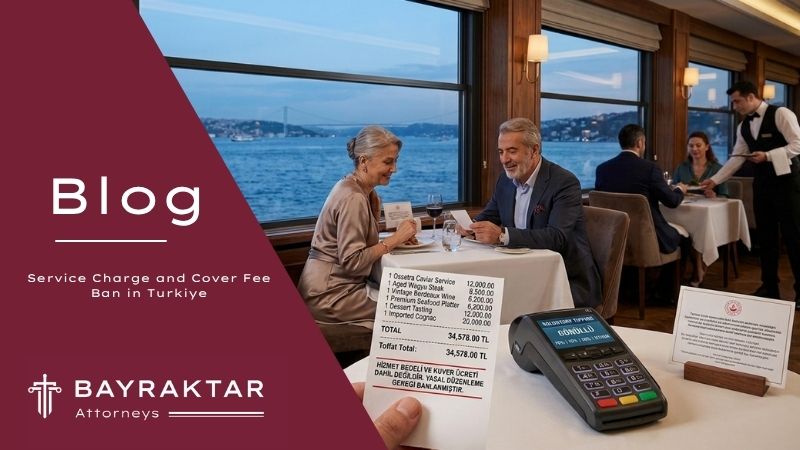
Customers may still choose, entirely on their own initiative, to leave a tip, bahşiş, whether in cash or through an electronic payment method. This remains lawful precisely because it is voluntary. A business cannot present a tip as compulsory, cannot automatically add a percentage to the bill and label it a tip, and cannot pressure staff to solicit or insist upon one. The reform is specifically aimed at mandatory and automatically applied charges; it places no restriction on a satisfied customer's own choice to leave something extra, and the Ministry has framed this as preserving customer choice while still curbing the practice it viewed as most harmful to price transparency. Similarly, items that a customer actually orders and consumes, including items that were traditionally bundled into a cover charge such as bread, water, or a welcome tea or coffee, can still be charged for individually, provided the price for each is clearly listed and the customer is informed the item carries a charge before it is served.
2.3 How Businesses Are Expected to Price Their Menus
The intended effect of the reform is that the price shown for an item is the final price a consumer pays for it, with any service, staffing, or operational cost the business wishes to recover built directly into that listed price rather than added afterward as a separate line. A cafe that previously charged 180 Turkish Lira for a coffee plus an additional service charge can lawfully price that same coffee at a single, higher, all inclusive figure; what it cannot do is continue listing two separate amounts, one for the coffee and one for service.
3. Enforcement Since the Reform
The Ministry of Trade, together with Provincial Directorates of Trade across all 81 provinces and municipal enforcement teams, has actively pursued compliance since the amendment took effect, reviewing receipts and comparing pricing before and after 30 January 2026 to identify businesses that continued the practice under a different label.
3.1 Direct Violations
Establishments that simply continued charging a separate service or cover fee after the effective date have faced administrative fines assessed on a per consumer, per transaction basis. Reported penalties in individual cases have run into the hundreds of thousands of Turkish Lira, reflecting fines calculated across dozens of separate violating receipts identified during a single inspection of one establishment's records.
3.2 Disguised Increases
A second, closely related enforcement focus has emerged around businesses that attempted to preserve their prior revenue by raising the listed price of items by the same amount the service charge used to add, immediately after the ban took effect, rather than through an ordinary, transparent price adjustment. In at least one documented case, a business openly stated it had done exactly this in order to protect staff income, a statement the Ministry treated as an admission of an unjustified price increase and a deceptive commercial practice, resulting in a fine exceeding 1.8 million Turkish Lira. The practical lesson for legitimate businesses is that incorporating a genuine cost increase into a menu price is lawful, but doing so in a way that is provably timed and sized to exactly replace a now prohibited charge invites scrutiny as an attempt to evade the reform rather than an ordinary pricing decision.
3.3 Menu and Price List Compliance
Inspections have also continued to examine the underlying price list obligations that predate this specific reform: that a complete, current price list is posted at the entrance and on every table, that digital or QR code menus match the posted list, and that no footnote or disclaimer anywhere, whether on a printed menu, a QR code menu, or a delivery platform listing, states that a service charge will be added to the bill. A menu that still contains this kind of footnote is treated as a compliance failure in its own right, independent of whether any specific bill actually included the prohibited charge.
4. What Consumers Can Do
A consumer who is charged a service, table, or cover fee in violation of the current rules, or who encounters a menu that still states such a charge will be applied, has several avenues available. The matter can be raised directly with the business at the time, since staff are expected to be able to explain clearly that no such separate charge applies. Where this does not resolve the issue, a complaint can be filed through the ALO 175 Consumer Hotline, through the Ministry of Trade's Unjust Price Increase Complaint System, or through the Consumer Information System accessible via e-Devlet. Where the consumer wants the improperly collected amount refunded, an application can be made to the competent Consumer Arbitration Board, which handles disputes below the annually revised monetary threshold, set at 186,000 Turkish Lira for 2026, meaning the great majority of restaurant billing disputes fall comfortably within the Board's jurisdiction.
5. Tax Treatment of Amounts Collected From Customers
The reform changes what businesses may lawfully collect, but the underlying tax principles governing amounts that do change hands remain relevant, particularly for genuinely voluntary tips and for any legacy questions arising from service charges collected before the ban.
5.1 Tips Are Generally Not Subject to Income Tax
The Council of State, Danıştay, has held that a tip, being a payment of undetermined amount made at the customer's own discretion and satisfaction directly to the person who served them, does not fall within the categories of payment treated as wages under Article 61 of the Income Tax Law, and is therefore not included in the tax base for wage withholding. This precedent, developed under the previous framework where service charges and tips coexisted, remains directly relevant now that voluntary tipping is the only additional amount a business may lawfully facilitate.
5.2 Amounts Pooled and Distributed by the Business Are Different
Where a business collects an amount from customers and then distributes it to staff according to its own internal system, rather than the amount passing directly and individually from a customer to the specific person who served them, that distributed amount is generally treated as wage income subject to income tax withholding once it reaches the employee, since it has effectively been processed through the employer rather than given directly as a personal gratuity. Businesses that pool electronic tips and redistribute them among staff on a schedule, rather than crediting each payment individually to the employee the customer intended to reward, should treat this distinction as a live compliance question rather than an assumption, and confirm the correct tax treatment with a qualified financial adviser given how differently it is treated depending on how the money actually moves.
5.3 VAT on Any Amount Actually Charged for Goods or Services Provided
Where a business does charge separately and lawfully for an item a customer actually ordered, for example a bread basket explicitly listed and priced on the menu, that charge remains subject to value added tax at the standard rate applicable to food and beverage sales, calculated and invoiced in the ordinary way alongside the rest of the bill.
5.4 An Emerging Practical Question: Documenting Voluntary Card Tips
Since the reform, industry representatives have flagged a genuine practical difficulty that the regulation itself does not fully resolve: when a customer leaves a tip by card rather than cash, inspectors reviewing point of sale records may struggle to distinguish a genuinely voluntary card tip from what looks, on the transaction record, like an automatically added charge, particularly where a business's payment terminal defaults to prompting for a tip percentage. Businesses relying on electronic tipping should ensure their payment systems clearly present tipping as an optional, customer initiated choice at the point of payment, and should keep records capable of demonstrating that any tip amount was selected by the customer rather than defaulted or pre filled by the system, since the burden of showing a charge was genuinely voluntary is likely to fall on the business in an inspection.
6. Practical Guidance for Food and Beverage Businesses
Businesses operating restaurants, cafes, or similar establishments in Türkiye should treat the following as a baseline compliance checklist going forward. Menus, whether printed, posted, or accessed through a QR code, should show only the prices of items a customer can actually order, with no separate line for service, table, or cover charges anywhere in the document, including in footnotes. Where a cost previously recovered through a service charge needs to be reflected somewhere, it should be built into the listed prices of the menu items themselves as part of an ordinary, transparent pricing decision, rather than introduced as a sudden, precisely matching increase immediately after the reform took effect. Point of sale and payment systems should present any tipping option as clearly optional and customer initiated, avoiding a default percentage that could be mistaken for a mandatory charge. Staff should be briefed on how to respond clearly and consistently if a customer asks what happened to the old service charge, since an improvised or inconsistent answer from staff is a common trigger for a complaint that leads directly to an inspection.
7. Frequently Asked Questions
7.1 Can a restaurant in Türkiye still charge a service fee if it is listed on the menu?
No. Since 30 January 2026, listing the charge no longer makes it lawful. Mandatory service, table, and cover charges are prohibited outright, regardless of disclosure.
7.2 Is tipping still allowed?
Yes. A customer may voluntarily leave a tip in cash or electronically. What is prohibited is a business adding a charge automatically or presenting it as compulsory under the label of a tip or otherwise.
7.3 Can a cafe still charge for bread, water, or a welcome coffee?
Only if the customer actually ordered it, the price is clearly listed, and the customer was informed before it was served. These items can no longer be bundled into an automatic cover charge that applies regardless of whether the customer wanted them.
7.4 What should I do if a restaurant still adds a service charge to my bill?
Raise it with the business first. If unresolved, you can complain through the ALO 175 Consumer Hotline, the Unjust Price Increase Complaint System, or the Consumer Information System on e-Devlet, and seek a refund through the competent Consumer Arbitration Board.
7.5 Is it legal for a business to raise its menu prices to make up for the lost service charge revenue?
An ordinary, transparent price adjustment is legal. However, a price increase that precisely and immediately replaces the banned charge, especially where the business itself states this was the reason, has been treated by the Ministry of Trade as an unjustified price increase and a deceptive practice, resulting in significant fines.
7.6 How is a fine for violating this rule calculated?
Fines have been applied on a per consumer, per transaction basis, meaning a business found to have improperly charged the fee across many separate receipts during an inspection can accumulate a substantial total penalty even where each individual charge was relatively small.
7.7 Are tips subject to income tax in Türkiye?
Generally no, where the tip passes directly and individually from the customer to the person who served them, consistent with established Council of State precedent. Amounts collected by the business and redistributed to staff through its own system are more likely to be treated as taxable wage income.
7.8 Does VAT apply to a tip?
A genuinely voluntary tip that is not part of the price of any good or service sold is generally treated differently from a mandatory service charge for VAT purposes, whereas any amount actually charged for an ordered item remains subject to standard VAT in the usual way.
7.9 Can a restaurant require menus to only be accessed by QR code?
No. A physical, current price list must still be posted at the entrance and available at the tables, in addition to any digital or QR code menu, and the two must match.
7.10 What is the monetary threshold for taking a restaurant billing dispute to the Consumer Arbitration Board?
186,000 Turkish Lira for 2026. Disputes below this value must go to the Board before any court action, which covers the overwhelming majority of restaurant billing complaints.
7.11 Does this reform apply to hotels, event venues, or catering, or only to restaurants and cafes?
The reform is directed specifically at businesses providing food and beverage service, such as restaurants, cafes, pastry shops, and similar establishments; other categories of business, such as hotels charging a separate banquet service fee for a private event, should confirm their specific situation separately rather than assuming identical treatment.
7.12 If a customer is pressured by staff to leave a tip, is that a rule violation?
Yes. The rule requires that any tip be based entirely on the customer's own free choice; pressuring customers or staff to solicit tips is inconsistent with the voluntary basis the reform requires.
7.13 Was the old rule allowing disclosed service charges ever formally struck down, or did it simply expire?
It was replaced by the January 2026 amendment to the Price Label Regulation itself, which removed the disclosure based allowance and substituted the current prohibition; businesses relying on guidance describing the earlier disclosure based system should treat that guidance as superseded.
7.14 What happens if my complaint is about a very small amount, such as a few Turkish Lira?
The Consumer Arbitration Board route remains available regardless of how small the disputed amount is, and the Kartal case involving a modest cover charge refund illustrates that even small amounts have been pursued successfully under the framework that governed this area before the outright ban.
8. Conclusion
The rules governing what a Turkish restaurant or cafe can add to a customer's bill changed fundamentally on 30 January 2026, moving from a disclosure based system that permitted service and cover charges provided they were listed, to an outright prohibition on any such mandatory charge regardless of how it is presented. Active enforcement since that date, including substantial fines for businesses that attempted to preserve the same revenue through disguised price increases, shows the Ministry of Trade is treating this as a serious compliance area rather than a symbolic change. Food and beverage businesses operating in Türkiye should review their menus, point of sale systems, and staff guidance against the current rule rather than relying on practices or advice that predate this reform.
For assistance reviewing your pricing structure, menu compliance, or a specific consumer complaint or Ministry inspection, our legal team can help you assess your current exposure and bring your practices in line with the rules now in force.