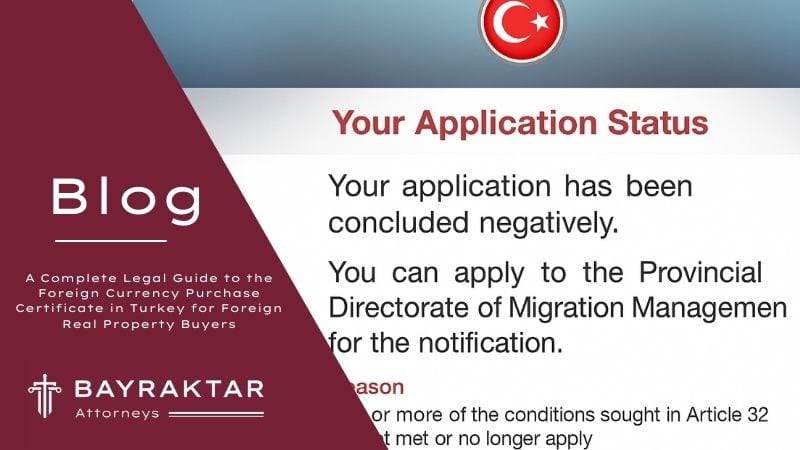
If you are a foreign national applying for a residence permit in Türkiye, understanding the legal grounds on which an application can be refused under the Law on Foreigners and International Protection, YUKK, is crucial. This article explains what the law actually says, and corrects a common point of confusion: the specific grounds for refusal, cancellation, or non-extension of a short term residence permit are set out in Article 33 of Law No. 6458, not Article 32, which instead lists the positive conditions an applicant must meet to be eligible in the first place.
Especially in cities like Istanbul, Ankara, Antalya, and Izmir, where thousands of foreigners apply each month, immigration officers apply these provisions with precision, and even a minor mistake can lead to a full rejection. At Bayraktar Attorneys, we have helped many clients respond effectively to residence permit rejections, often overturning unfair or misunderstood decisions.
Quick Answer: The specific legal grounds on which a Turkish short term residence permit application can be refused, or an existing permit cancelled or not extended, are set out in Article 33 of the Law on Foreigners and International Protection, Law No. 6458. Article 32 of the same Law, which is often mistakenly cited for this purpose, actually lists the positive eligibility conditions an applicant must satisfy, such as not being barred from entry under Article 7 and having suitable accommodation, rather than the grounds for rejection itself. Common reasons for refusal under Article 33 include passport or documentation problems, an active entry ban, public order, security, or health concerns, insufficient financial means, inadequate health insurance, and failure to prove the purpose of stay.
1. Article 32 and Article 33: Two Different Provisions Often Confused
This mix-up is understandable and common, since both articles sit in the same part of Law No. 6458 dealing with short term residence permits, and both are relevant to whether an applicant ultimately succeeds. But they answer different questions, and knowing which one actually governs a rejection decision changes how an objection or appeal should be framed.
1.1 Article 32: The Positive Conditions to Apply
Article 32 of Law No. 6458 sets out the conditions required for a short term residence permit to be granted in the first place. In broad terms, an applicant must not fall within the category of foreigners barred from entering Türkiye under Article 7, must have accommodation meeting general health and safety standards, must provide a criminal record certificate from their country of nationality or lawful residence if requested, and must provide their address information in Türkiye. This is a positive checklist of what an applicant needs to demonstrate, not a list of grounds for refusing an application that otherwise meets these conditions.
1.2 Article 33: The Actual Grounds for Refusal, Cancellation, or Non-Extension
Article 33 of the same Law is the provision that specifically addresses the circumstances under which a short term residence permit application will not be granted, an existing permit may be cancelled, or its extension may be refused. This is the provision genuinely relevant to a rejected residence permit application, and understanding this article can help you prepare a stronger application, or defend yourself effectively if you face a rejection, since citing the correct provision matters when framing an objection or appeal.
The practical difference matters most at the objection stage. An objection or appeal that attacks the wrong legal basis, arguing at length that an applicant met the Article 32 eligibility conditions when the actual rejection was issued under a specific Article 33 ground, addresses a point the authorities never disputed in the first place. Confirming which article, and which specific ground within it, the rejection decision actually cites is therefore the necessary starting point before drafting any response.
2. Most Common Reasons for Residence Permit Rejection Under Article 33
2.1 Missing or Invalid Passport or Travel Document
Applications are often denied if the passport is expired or will expire within 60 days of the intended residence period, no passport is submitted at all, or the passport is identified as fake or altered.
2.2 Entry Ban or Immigration Violation
If you have been banned from entering Türkiye for overstaying or violating visa rules, or were deported in the past and the ban is still active, your application will generally be rejected on this basis.
2.3 Public Order, Security, or National Safety Risk
Turkish authorities have the right to reject any applicant considered a risk to public security, public order, or national safety. This includes individuals with certain criminal records or suspected ties to criminal networks or terrorist organisations.
2.4 Public Health Risks
Applications may be denied if the applicant has a contagious disease that poses a risk to public health in Türkiye, or cannot provide health clearance when requested by the authorities.
2.5 Inadequate Financial Means
Applicants must prove they have enough income or financial support to live in Türkiye. Common problems include the absence of bank statements or income documents, inconsistent or insufficient financial information, and no clear explanation of how living expenses will be covered. Our top tips on the income statement for a Turkish residence permit application can help you avoid this pitfall.
2.6 Lack of Valid Health Insurance
Every residence permit applicant must have valid health insurance covering the entire duration of their stay. Applications are rejected when insurance is missing, expired, does not cover the full stay period, or comes from a provider not recognised by Turkish authorities. See our overview of health insurance for a residence permit in Türkiye to make sure your policy qualifies.
2.7 Inability to Prove Purpose of Stay
You must provide documents explaining why you are staying in Türkiye. Reasons such as tourism, study, family reunion, or real estate investment must be supported by proof of address, a rental contract or title deed, TAPU, school enrolment, or business licences and company papers, as appropriate to the stated purpose.
If you are new to the process generally, our comprehensive guide to residence permit applications in Turkey is a useful starting point before you reach the stage of worrying about a rejection at all.
3. What to Do If Your Residence Permit Is Rejected Under Article 33
If you receive a rejection notice, it is important to stay calm and act quickly.
3.1 Read the Rejection Decision Carefully
The reason for rejection will be clearly stated. Use this to identify what went wrong and what can be corrected, and to confirm which specific ground under Article 33 the authorities relied upon.
3.2 File an Administrative Objection
You can submit a written objection to the immigration office that handled your application. In your objection, you should correct any errors or omissions, provide missing documents, and explain your case clearly and on a proper legal basis.
3.3 Appeal to the Administrative Court
If your objection is denied, you may file a lawsuit at the Administrative Court. This is a formal legal process and should be handled with the assistance of a licensed immigration lawyer. Our guide to navigating the Turkish residence permit appeals process explains what to expect.
3.4 Reapply with Corrected Documents
Sometimes the best course is to correct the underlying problem and reapply. This is common where the rejection stemmed from missing financial proof, invalid insurance, or an incomplete explanation of the purpose of stay.
3.5 Get Legal Support
Turkish immigration laws and their practical application are detailed and can change; internal guidance or seasonal shifts in emphasis can affect which permit types are approved more readily at a given time. Having a lawyer helps you understand the current practical climate, submit a legally strong application citing the correct provisions, and avoid repeat rejections. For a structured approach, review the four important steps for responding to a residence permit rejection.
4. Real World Scenario: How Bayraktar Attorneys Helped
One of our clients from India was rejected under Article 33 due to inadequate financial proof. The client had submitted personal bank statements but failed to include a notarised rental contract and health insurance. We submitted an administrative objection with updated financial proof, a valid lease agreement, and health coverage from a Turkish insurer. The rejection was overturned in less than four weeks.
5. How to Avoid Rejection From the Start
At Bayraktar Attorneys, we help clients prepare strong residence permit applications by ensuring all documents are complete and valid, the purpose of stay is clear and provable, financial and health insurance documents are sufficient, and the application is submitted before the current visa or permit expires.
6. Frequently Asked Questions
6.1 Is it Article 32 or Article 33 that governs residence permit rejections?
Article 33. Article 32 lists the positive conditions an applicant must meet to be eligible for a short term residence permit; Article 33 sets out the grounds on which the permit can actually be refused, cancelled, or not extended.
6.2 What does Article 32 actually cover, if not rejection grounds?
It covers the eligibility conditions for a short term residence permit, including not being barred from entry under Article 7, having accommodation meeting health and safety standards, providing a criminal record certificate when requested, and providing an address in Türkiye.
6.3 What is the most common documentation problem leading to rejection?
Passport issues are among the most common, including a passport that will expire within 60 days of the intended residence period, a missing passport, or one identified as fake or altered.
6.4 Can a past deportation permanently prevent me from getting a residence permit?
Not necessarily permanently, but an active entry ban resulting from a past deportation will generally lead to rejection until that ban is lifted or successfully challenged through the appropriate legal route.
6.5 What counts as sufficient proof of financial means?
Consistent, clear bank statements or income documents that plausibly cover your living expenses in Türkiye; vague, inconsistent, or incomplete financial information is a common cause of rejection.
6.6 Does my health insurance need to be from a Turkish provider?
It needs to be from a provider recognised by Turkish authorities and needs to cover the full duration of the intended stay; not every foreign policy automatically qualifies, so this should be confirmed before applying.
6.7 What should I do first if I receive a rejection notice?
Read the decision carefully to identify the specific stated reason, since this determines whether an administrative objection with corrected documents, or a different course of action entirely, is the more appropriate next step.
6.8 Is legal representation required to object to a rejection?
Not strictly required for the initial administrative objection, but it is strongly advisable, and becomes considerably more important if the matter proceeds to the Administrative Court.
6.9 Is reapplying always better than objecting to a rejection?
Not always; it depends on the specific reason for rejection. Where the issue is a straightforward missing document, correcting it and reapplying can be efficient, while other grounds, such as a disputed security concern, are usually better addressed through a formal objection or appeal.
6.10 What happens if my administrative objection is also denied?
You may file a lawsuit at the Administrative Court, a formal legal process that should be handled with the assistance of a licensed immigration lawyer given its procedural requirements.
6.11 Does a work permit rejection follow the same process as a residence permit rejection?
No, a different provision applies. If your work permit was refused, see our guide on what to do when a Turkish work permit application is denied under Article 9-a.
6.12 Can I avoid rejection entirely with careful preparation?
Most rejections stem from avoidable issues, such as incomplete documentation, insufficient financial proof, or an unclear purpose of stay, so careful preparation before submission meaningfully reduces the risk, though it cannot eliminate discretionary grounds such as security assessments.
6.13 Why does it matter which specific ground under Article 33 was cited in my rejection?
Each ground requires a different response. A passport related rejection is corrected by submitting a valid document, while a public order or security concern generally requires a substantive legal argument, so identifying the exact ground shapes the entire strategy for the objection or appeal.
6.14 Does the fact that my case involves Article 33 rather than Article 32 change where I file an objection?
No. The filing venue, the immigration office that handled the application, and the subsequent Administrative Court route if needed, remain the same regardless of which specific ground within Article 33 was applied; what changes is the substance of the argument raised.
7. Final Thoughts
Article 33 is a powerful tool available to Turkish immigration authorities, but it does not have to be the end of your journey. With professional legal support and correct documentation, most rejections can be avoided or reversed, and understanding precisely which provision applies, rather than relying on a commonly repeated but inaccurate article citation, puts you in a stronger position from the outset.
If you are applying for a residence permit in Türkiye, or have been rejected under Article 33, Bayraktar Attorneys is ready to help. Contact us today for reliable, experienced guidance on residence permit applications, rejections, and appeals under Turkish law.